- Which face belongs on the twenty dollar bill?
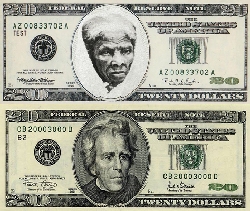 Last Spring, an on-line poll was created soliciting suggestions for a woman to replace President Andrew Jackson on the twenty dollar bill. Over 600,000 people voted and on May 13th, the results were announced whereby abolitionist Harriet Tubman won, passing former First Lady Eleanor Roosevelt and Civil Rights activist Rosa Parks.
The selection of Tubman certainly will please women's activists as well as African-Americans. Tubman's biography is a remarkable story of survival and determination to free slaves in the South. Frankly, our youth should read about her as it is very inspirational. In addition to being an abolitionist, she was a humanitarian and during the Civil War, a Union spy. When Tubman passed, she was buried in Auburn, NY with semi-military honors. A plaque was hung at the Auburn courthouse noting her achievements. The great Booker T. Washington delivered the keynote address. Many other honors followed, leading to having her portrait replace Jackson's on the twenty dollar bill.
Although I think the recognition is deserved, I question why her proponents have targeted Jackson. I, for one, do not believe in change for the sake of change, and as someone who has studied Jackson, I do not believe they remember what he meant to the country.
If they studied the Wikipedia description of "Old Hickory," as well as other sources, they would find an impressive list of achievements:
As soldier:
- Served in the Revolutionary War at age 13, informally helped the local militia as a courier.
- Captured by the British and held as prisoner; nearly starved to death in captivity.
- Captured by the British and held as prisoner; nearly starved to death in captivity.
Legal:
- Served as a country lawyer on the frontier.
- Elected as a delegate to the Tennessee constitutional convention in 1796.
- When Tennessee achieved statehood that year, Jackson was elected its U.S. Representative.
- The following year, he was elected U.S. Senator.
- Appointed a judge of the Tennessee Supreme Court in 1798, serving until 1804.
- Elected as a delegate to the Tennessee constitutional convention in 1796.
- When Tennessee achieved statehood that year, Jackson was elected its U.S. Representative.
- The following year, he was elected U.S. Senator.
- Appointed a judge of the Tennessee Supreme Court in 1798, serving until 1804.
Military career:
- Appointed commander of the Tennessee militia in 1801, with the rank of colonel. He was later elected major general of the Tennessee militia in 1802.
- Defeated the Red Sticks at the Battle of Horseshoe Bend in 1814.
- Defeated the Red Sticks at the Battle of Horseshoe Bend in 1814.
As General:
- Victory over the main British invasion army at the Battle of New Orleans, 1815, thereby becoming a national hero.
- Sent to Florida where he deposed a small Spanish garrison, leading directly to the treaty which formally transferred Florida from Spain to the United States.
- Became military governor of Florida while it was being integrated as a U.S. territory.
- Sent to Florida where he deposed a small Spanish garrison, leading directly to the treaty which formally transferred Florida from Spain to the United States.
- Became military governor of Florida while it was being integrated as a U.S. territory.
As 7th president of the United States:
- Believed the president's authority was derived from the people and the presidential office was above party politics.
- Strongly believed in the Union, but was also a supporter of states' rights.
- In an effort to purge the government from corruption of previous administrations, Jackson launched presidential investigations into all executive Cabinet offices and departments.
- Put down a threat of secession from South Carolina.
- Disposed of the Second Bank of the United States.
- Balanced the budget and got the country out of debt. (As an aside, this was of particular interest to me, as Jackson was one of only a handful of presidents to balance the budget, and perhaps the only one in the 19th century to do so.)
- Settled spoils of war claims with France, Denmark, Portugal, and Spain.
- Made trade agreements with Russia, Spain, Turkey, Great Britain, and Siam (the first in Asia).
- First to recognize the independent Republic of Texas (which was later annexed).
- The "Jackson Era" greatly influenced politics in America for several years after his term of office.
- Jackson was elected twice to office, the last to do so until Abraham Lincoln.
- Strongly believed in the Union, but was also a supporter of states' rights.
- In an effort to purge the government from corruption of previous administrations, Jackson launched presidential investigations into all executive Cabinet offices and departments.
- Put down a threat of secession from South Carolina.
- Disposed of the Second Bank of the United States.
- Balanced the budget and got the country out of debt. (As an aside, this was of particular interest to me, as Jackson was one of only a handful of presidents to balance the budget, and perhaps the only one in the 19th century to do so.)
- Settled spoils of war claims with France, Denmark, Portugal, and Spain.
- Made trade agreements with Russia, Spain, Turkey, Great Britain, and Siam (the first in Asia).
- First to recognize the independent Republic of Texas (which was later annexed).
- The "Jackson Era" greatly influenced politics in America for several years after his term of office.
- Jackson was elected twice to office, the last to do so until Abraham Lincoln.
Miscellaneous:
- Became the leader of the new Democratic Party.
- Master Mason, becoming the Grand Master of Tennessee.
- Master Mason, becoming the Grand Master of Tennessee.
Jackson was certainly not without his faults. He was censured by the Senate in 1834 as a political move by Henry Clay. He owned slaves on his plantation in Tennessee, and relocated Native American tribes living east of the Mississippi, to quell attacks and stabilize the country, a very controversial move, both then and now.
Even with his faults, Jackson was a giant among U.S. Presidents. He brought peace and prosperity to the country, and made the United States a world power to be reckoned with.
I am not trying to make a comparison between the greatness of Harriet Tubman versus Andrew Jackson, only to remark our 7th president has certainly earned a right to have his portrait on the twenty, and his removal would cause young people to forget his contributions in American history. It may also be an affront to Democrats who may resent slighting their former leader.
How about a compromise? Such as creating a $25 bill with Tubman's face on it? I always thought a $25 note made more sense than the twenty, e.g.; four bills to make $100 as opposed to five. It would be a clever way to honor two great Americans, and not offend proponents of either of them.
Keep the Faith!
Note: All trademarks both marked and unmarked belong to their respective companies.
 Tim Bryce is a writer and the Managing Director of M&JB Investment Company (M&JB) of Palm Harbor, Florida and has over 30 years of experience in the management consulting field. He can be reached at timb001@phmainstreet.com
For Tim's columns, see:
timbryce.com
Like the article? TELL A FRIEND.
Copyright © 2015 by Tim Bryce. All rights reserved.
NEXT UP: THE MUCKRAKING HAS BEGUN - The political mud slinging has already begun.
LAST TIME: JUST PLAIN WEIRD - Some obscure observations on the mysteries of life.
Listen to Tim on WJTN-AM (News Talk 1240) "The Town Square" with host John Siggins (Mon, Wed, Fri, 12:30-3:00pm Eastern); WZIG-FM (104.1) in Palm Harbor,FL; and KIT-AM 1280 in Yakima, Washington "The Morning News" with hosts Dave Ettl & Lance Tormey (weekdays. 6:00-9:00am Pacific). Or tune-in to Tim's channel on YouTube.


 I have always found the little nuances of life to be bewildering. You know, things we tend to overlook or take for granted. Yet, when you examine them closely, you wonder why there are the way they are. For example, have you ever noticed the "cups" marked on a coffee pot? Mine shows twelve, but I can barely get six cups of coffee out of them. Maybe the manufacturer doesn't have the same interpretation of "cup" that I have or the pots are designed for Munchkins. Then again, most of these pots are made in China.
 In the past, I have discussed the adverse effects of technology, focusing on its addictive powers on a personal level, (see
  Brainstorming is back in the news for management. The idea of creating new ideas is certainly not old, but most people tend to take a shotgun approach, meaning they schedule a meeting and bounce ideas off of each other. I have never seen this approach work in a corporate setting. Instead, I have always found a methodical approach works better.
 We recently released our popular "MORPHING INTO THE REAL WORLD - A Handbook for Entering the Work Force" as an eBook. The book represents a survival guide for young people as they transition into adult life. It includes chapters to describe how a young person should organize themselves, how to adapt to the corporate culture, develop their career, and improve themselves professionally and socially. Basically, its 208 pages of good sound advice to jump start the young person into the work force.
 It is always a pleasure visiting places where the citizens take pride in their community and are civic minded. Such is the City of
  Whenever I mention I am in the "Systems" business, people generally look at me befuddled, smile, and shake their heads. I can tell they haven't got a clue what I am talking about. Many assume it has something to do with computers, and those in the technology sector assume I am referring to software. Frankly, no. What most people do not comprehend is that we are surrounded by systems. Life, as we know it, would be unfathomable without them.
 Something just about all of us consider at some point in our lives is our legacy, be it on a small scale such as a job or project, or our life's work. Nagging questions linger, "How will I be remembered?", "Did I do a good job?" or "Was my life well spent?" Some people believe we are judged by physical objects such as a building we constructed, the development of some object, or perhaps an invention. Others consider our impact on productivity and prosperity through such things as leadership, organization, and systems. The fallacy here is that buildings and products inevitably deteriorate, processes and inventions evolve and are replaced, so notoriety for such things is fleeting. To compound the problem, we have no real sense of history and quickly forget who did what years ago.
 As we approach the 2016 presidential election, I am hearing a new line of spin from Democrats attempting to poison the portrayal of Republicans. For example, I am starting to hear the term "fascist" when describing conservatives. One person recently wrote me, "I would much rather be a socialist than a fascist." The intent was obviously to make a derogatory slur. The word itself, "fascist," is admittedly a bit nebulous for most people who will likely repeat its usage out of ignorance.
 There is no denying it, these are crazy times we live in. Just turn on the evening news and you know what I mean. It seems our government is in a perpetual state of turmoil, protests and riots are happening (and may even get worse with a hot summer), we hear of terrorists, and people being cruel to their families and animals, etc. At work, there are managers sitting over their employees with a whip and a chair, orders are not processed on time, customer complaints seem to be rising, and cheating and greed is everywhere. And nonprofits turn into petty political fiefdoms. It's all rather mind-numbing.
 Ever notice as we grow older we tend to slow down. I have a theory on this. It's not that we're physically incapable of performing certain tasks, we're just a lot smarter. Sure, we are not as strong or fast as we once were, but we are still able to handle the chores around the house. For example, I have a 98 year old friend who still mows his lawn. His eyesight has been waning, which caused him to turn in his drivers license and sell his car, but he still tends to his household, maybe not as robustly as he once did, but he tends to his chores nevertheless. As an aside, he was smart enough to know his limitations, causing him to voluntarily forfeit his license. Some keep driving well after they are capable of doing so and often end up in accidents, but not my friend.
 In lieu of the riots in Baltimore, I thought I would talk about the importance of family values. Like millions of people, I watched in horror at the "protestors" on television. Perhaps a better name is "rioters" or "thugs" (regardless if it is politically correct or not, it is an apt description). The brightest spot though, was