Search This Blog

Tuesday, September 4, 2018

WAS AMERICA EVER GREAT?

BRYCE ON POLITICS

- You betcha.

Click for AUDIO VERSION.
To use this segment in a Radio broadcast or Podcast, send TIM a request.
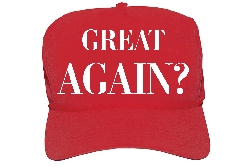
In defiance of President Trump, New York Governor Andrew Cuomo recently declared, "America was never that great," an unfortunate comment which will cost him points politically. Even his father, former NY Governor Mario Cuomo, would have trouble swallowing it as he was well known for his stories of his family's humble beginnings as Italian immigrants, that America was indeed the "land of opportunity." The declaration made by today's governor is in keeping with the left's position that the country is desperately in need of a makeover, and certainly not in keeping with President Trump's policies.

Nonetheless, they beg the question, "Was America ever great?" A lot of people tend to think so...

* Ask the Europeans who we aided to free the continent from Nazism and Fascism, and the "Marshall Plan" to rebuild it.

* Ask the Russians about how "Lend-Lease" saved their hides from German destruction.

* Ask Japan and South Korea who we helped rebuild into powerful economic engines.

* Ask the victims saved by the ravages of Polio and other diseases we helped find cures for.

* Ask the victims of the many countries who suffered through disasters, such as earthquakes, hurricanes, and typhoons. Ask who fed them, gave them shelter and medicine, and helped them get back on their feet.

* Ask the millions of people in this country who can now easily travel and communicate from coast-to-coast.

* Ask the millions of people around the world who have found enjoyment in our music, films, theater, and art.

* Ask the millions of Americans who enjoy one of the highest standards of living in the world.

They will all say, "Yes, America was great." By the way, has anyone forgotten we were the first country to land on the moon (and still the only ones to do so 50 years later)? This little feat invigorated our country, not just educationally, but caused the creation of new technologies and jobs.

However, there is a difference between being great and being perfect. Even President Trump is well aware of our imperfections, as we all should be, but this shouldn't make us any less proud of our achievements. Thanks to our melting pot of multiple cultures, there is still a spirit of invention, innovation, creativity, and productivity. Over time though, we slipped and made it possible to ship jobs and companies overseas due to stifling government regulation and economics. We allowed others to dominate industries simply by enacting trade barriers against American products and services. All of this affected our GDP, the number of people on unemployment, our trade deficit, and the national debt, simply because we chose a policy of following as opposed to leading the free world.

The truth is, there are people who want us to be ashamed of our accomplishments, as they want to undermine the government and replace it with something new. This includes the media, academia, and the far left. The reality though is the U.S. Constitution and Bill of Rights have served us well for over 200 years and will continue to do so if we allow it. During his campaign, President Trump hit a nerve with people when he said, "Make America Great Again." Deep-down most Americans want to feel proud of our country and ourselves again, that we will do what is right to protect our country, that we can build superior products, do big things, and be a beacon of light; to prove the American experiment still works, despite those who would rather see us fail.

There are people who simply do not believe in American greatness and will go to any length to see it abolished. Let me give you one tiny example; like many of you, I have watched various presentations at the White House via a Facebook feed. Although most people comment on how they enjoy watching it, there is always a handful trying to malign the event. To illustrate, recently there was a Medal of Honor presentation given to a fallen airman posthumously, Tech. Sgt. John A. Chapman. During the presentation, I looked at the number of people voting their pleasure of the event, whereby there were 5.3K who liked it, and 390 who laughed at it. I'm not sure why they laughed; perhaps because it was President Trump making the presentation, or maybe they think the Medal and Sgt. Chapman are a joke. Whatever the reason, it denotes hostility towards the country. It is this small group who, I am sure, doesn't believe America was great, but what they do not realize, most Americans do.

As we approach the midterm elections, this question of American greatness will occur again. The Democrats are playing with fire on this issue, which will be a key factor in turning independents away from voting for their party, and cause them to vote Republican.

Keep the Faith!

Note: All trademarks both marked and unmarked belong to their respective companies.
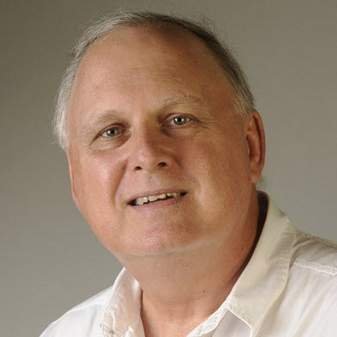
Tim Bryce is a writer and the Managing Director of M&JB Investment Company (M&JB) of Palm Harbor, Florida and has over 40 years of experience in the management consulting field. He can be reached at timb001@phmainstreet.com

For Tim's columns, see:   timbryce.com

Like the article? TELL A FRIEND.

Copyright © 2018 by Tim Bryce. All rights reserved.

Listen to Tim on WZIG-FM (104.1) in Palm Harbor,FL; Or tune-in to Tim's channel on YouTube. Click for TIM'S LIBRARY OF AUDIO CLIPS.

Friday, August 31, 2018

A POSTMORTEM OF THE 2018 FLORIDA PRIMARY

BRYCE ON POLITICS

- And what to expect in the mid-terms on November 6th.

Click for AUDIO VERSION.
To use this segment in a Radio broadcast or Podcast, send TIM a request.

The Florida primary was held last Tuesday (Aug 28, 2018), and the field of Republicans and Democrats have been whittled down to one per party. The number of votes cast, and the delegates selected give us a glimpse as to what to expect November 6th, not just here in the Sunshine State, but around the country.


U.S. SENATE
Rick Scott (R)
Bill Nelson (D)
Comment: This will be a contest between an out-going GOP Governor who reduced unemployment and created jobs, versus a career politician (22 years in the House (11 terms), 18 years in the Senate (3 terms))who followed party lines. Because of his tenure and voting record, Nelson is vulnerable.

U.S. HOUSE, DISTRICT 12
Gus Bilirakis (R)
Chris Hunter (D)
Comment: Bilirakis is the incumbent, serving since 2007, and is a strong advocate for veterans. He faces a serious challenge in Hunter, a former federal prosecutor and FBI agent.

U.S. HOUSE, DISTRICT 13
George Buck (R)
Charlie Crist (D)
Comment: Former Governor and Republican Crist is the incumbent and ran unopposed as a Democrat. Newcomer Buck has an up-hill battle on his hands.

GOVERNOR
Ron DeSantis (R)
Andrew Gillum (D)
Comment: This will be the most visible race in the state and will set the tone for all others. Rep. DeSantis is pro-Trump (having been endorsed by the President), versus anti-Trump candidate Gillum. Gillum surprised a lot of people by defeating Gwen Graham in the primary. His experience primarily includes serving as Mayor of Tallahassee. He is a Progressive and endorsed by Sen. Bernie Sanders.

ATTORNEY GENERAL
Ashley Moody (R)
Sean Shaw (D)
Comment: Moody possesses an extensive legal career, including commercial litigation, Federal prosecutor, and Circuit Court judge. Shaw's background is as the state’s Insurance Consumer Advocate. Hand's down, Moody has more experience.

AGRICULTURE COMMISSIONER
Matt Caldwell (R)
Nicole "Nikki" Fried (D)
Comment: Caldwell pulled off a bit of a surprise by defeating Denise Grimsley and Baxter Troutman. Caldwell is endorsed by Sen. Marco Rubio and the NRA. He is also an avid Constitutional Conservative. Fried is from Miami, an attorney, and helped expand access to medical marijuana. She claims, "Our politics and our government is broken."

And from around the Pinellas County area, we have:

STATE SENATE, DISTRICT 16
Ed Hooper (R)
Amanda Hickman Murphy (D)
Comment: Murphy is a former member of the Florida House. She will be running against Hooper, a career politician who has generated a lot more campaign funds than his opponent.

STATE REPRESENTATIVE, DISTRICT 64
James Grant (R)
Jessica Harrington (D)
Comment: Harrington, a school teacher, will be running against incumbent Grant.

STATE REPRESENTATIVE, DISTRICT 65
Chris Sprowl (R)
Sally Laufer (D)
Comment: Former Assistant State Attorney and incumbent Sprowls faces Progressive newcomer Laufer.

STATE REPRESENTATIVE, DISTRICT 66
Nick DiCeglie (R)
Alex Heeren (D)
Comment: Heeren is another former teacher looking to support his community. He will face DiCeglia who is a business owner and GOP county head. Hard to read this one; could be a coin-toss.

STATE REPRESENTATIVE, DISTRICT 67
Christopher Latvala (R)
Dawn C. Douglas (D)
Comment: Douglas is a newcomer and another school teacher vying against incumbent Latvala. She may be without the financial resources to adequately fight.

STATE REPRESENTATIVE, DISTRICT 68
Ben Diamond (D)
Comment: Running unopposed, incumbent.

STATE REPRESENTATIVE, DISTRICT 69
Ray Blacklidge (R)
Jennifer Webb (D)
Comment: Blacklidge is a local attorney and businessman, as well as life-long Republican. Webb is active in her community.

STATE REPRESENTATIVE, DISTRICT 70
Wengay "Newt" Newton (D)
Comment: Running unopposed, incumbent.
NOTE: This list does not include candidates for County Commissioners, School Board, or Fire Commission.
For the complete list of candidates, including the Pinellas County School Board, click HERE.

CRUNCHING THE NUMBERS

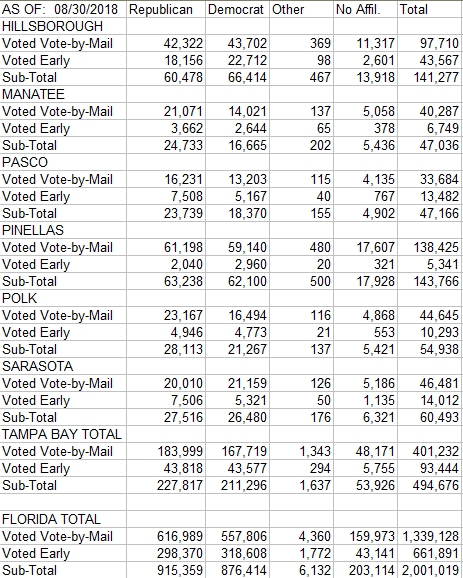
Although the election day data has not yet been posted, showing votes by counties and party, the final numbers are in in terms of Votes-by-Mail (absentee) and early voting. The data shown here is most illuminating.


Here we clearly see Republicans like to vote by absentee ballot (write-in), and Democrats prefer early-voting in person.

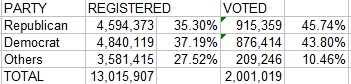
According to the Florida Department of State, Board of Elections, the number of registered Florida voters eligible to vote in the Primary included:


This means Democrats had the advantage going into the primary election, but allowed Republicans to cast more votes. This implies Democrats still do not like to vote in mid-term elections.

Over 2 million people voted in Florida prior to election day, an admirable number, but it pales in comparison to the 2016 presidential year figures which is typical.

- There were 832,052 less early-votes in the Tampa Bay area than the 2016 election (1,326,728); in other words 62.8% less.

- In Florida, 4,510,659 less early-votes in Florida than the 2016 election (6,511,678); in other words 69.3% less.

       REP    DEM    OTHRS
2016   39.5%  38.0%  19.5%
2018   45.7%  43.8%  10.4% 


In other words, from a percentage perspective, Republicans were more active than 2016, and the Democrats did not keep pace. However, notice the "OTHRS" figure, representing independents; as this was a primary, the percentage is down; again, this is to be expected as the primary is a race for the parties. The Independents though are the real prize as that number will go up for the November 6th election.

SO WHAT CAN WE EXPECT GOING INTO THE NOVEMBER ELECTION?

It appears the Republicans are cognizant of what is at stake in this election and are not taking anything for granted. If they lose, and the Congress falls into the hands of the Democrats, they fear their president will face impeachment. They are also deeply satisfied with the economic changes in the country since Mr. Trump entered the White House. As such, Florida Republicans are unified and determined. They are rallying around their President and are showing up in force to vote. At the state level, they fear a liberal agenda will force higher taxes and threaten the second amendment.

If you read the campaign pages of the Democrats, you'll notice a common theme: "Florida is broken," and, "We need to put the interests of the people above those of special interests." The question is, will Independents buy it? The Democrats' problem is they have yet to devise a compelling argument to vote for them, other than to resist President Trump. They also offer the enticement of more freebies, particularly college education, but the taxpayers know they will get stuck with the bill. In other words, the Democrats are stuck in a rut. And please, forget the mantra of Socialism; it will simply not fly down here where people have worked hard all their lives to retire.

What we are about to witness here in Florida, as well as elsewhere across the country, is an ugly brawl pitting the pro-Trump forces against the anti-Trumpers. The real fight is over the votes of the Independents. If they believe the country is better economically and in need of tougher laws on immigration, they will side with the GOP. If not, they will go with the Democrats.

Frankly, I see a "Red Tide" coming to Florida in November, certainly not blue. I would like to believe the other states will follow suit, but I will only comment on Florida herein.

Keep the Faith!

Note: All trademarks both marked and unmarked belong to their respective companies.

Tim Bryce is a writer and the Managing Director of M&JB Investment Company (M&JB) of Palm Harbor, Florida and has over 40 years of experience in the management consulting field. He can be reached at timb001@phmainstreet.com

For Tim's columns, see:   timbryce.com

Like the article? TELL A FRIEND.

Copyright © 2018 by Tim Bryce. All rights reserved.

Listen to Tim on WZIG-FM (104.1) in Palm Harbor,FL; Or tune-in to Tim's channel on YouTube. Click for TIM'S LIBRARY OF AUDIO CLIPS.
Thursday, August 30, 2018

HOW "EFFECTIVE" WERE YOU TODAY?

BRYCE ON MANAGEMENT

- There is an important difference between effectiveness and efficiency.

Click for AUDIO VERSION.
To use this segment in a Radio broadcast or Podcast, send TIM a request.

"Productivity = Effectiveness X Efficiency" - Bryce's Law

INTRODUCTION

Okay, you believe you had a great day at work today; that you accomplished a lot. Maybe you did. Then again, maybe you didn't do as much as you might think. A lot of people believe just because they are a model of efficiency, they are being highly productive. This is simply not true. We have discussed the concept of productivity on more than one occasion in this column, but some trends in the business world have caused me to revisit it again.

Perhaps the biggest problem here is that people fallaciously equate efficiency with productivity. They are most definitely not synonymous. Efficiency is concerned with speed of delivery, reduced errors, and minimal costs or effort. In other words, how fast we can perform a given task, at reduced costs, without committing any substantial errors in the process. But what if we are performing the wrong task at the wrong time? Obviously this would be counterproductive regardless how efficiently we performed the task. I always use the example of industrial robots on an assembly line, whereby they can perform tasks such as welding very efficiently. However, if they are welding the wrong thing at the wrong time, they are counterproductive.

This means there are two variables involved with productivity: efficiency and effectiveness. Whereas efficiency primarily deals with speed and "doing things right," effectiveness is concerned with "doing the right things." In other words, working on assignments in the right sequence. Sequence can be defined for a single project by its work breakdown structure (WBS) and precedent relationships, or for working on multiple projects based on priority.

ANALYZE THIS

To better understand the differences between effectiveness versus efficiency, I have developed an MS Excel spreadsheet where you can test your own personal productivity. Click HERE to download.

In the first part, I ask you to assess your sense of efficiency for the day; for example:
- I was a dynamo today; worked fast, no errors.
- I did more than my share, not too many mistakes.
- I did my fair share, average number of mistakes.
- I was below average, some mistakes.
- Had a bad day; too many mistakes, a lot of time lost.

Next, I ask you to consider your current work assignments in priority order. In other words, consider the projects you worked on from the highest to lowest priority. In some cases, people may have only one work assignment, which is fine.

Following this, I want you to account for your time during the day; both the time spent on project assignments, as well as indirect activities (such as attending meetings, breaks, checking e-mail, etc.). In other words, the interferences or activities not directly related to your work assignments. Be honest now, everybody spends time during the day on such indirect activities. By the way, on the average, office workers spend 70% of their time on direct project work and 30% on interferences.

The spreadsheet will then calculate a productivity rating based on the time spent on projects in priority sequence, and taking into account time spent on interferences.

WHAT DOES THIS MEAN?

The spreadsheet provides a convenient way to understand how productivity should be calculated. It is far from scientific (for example, the efficiency rating is crudely estimated without any level of precision). Nonetheless, the productivity number highlights the differences between efficiency and effectiveness.

I have seen companies who like to plot efficiency ratings on a graph, but as far as I am concerned the data is misleading as they only portray a glimpse of a much larger picture. Plotting the effectiveness rating is just as important as the efficiency rating and helps produce a realistic productivity rating.

CONCLUSION

Some workers, particularly craftsmen, understand the differences between efficiency and effectiveness. They appreciate the total process for building something and are acutely aware of the potential risk for cutting corners. Some simply don't get it (and probably never will). For example, the Information Technology industry commonly misunderstands this concept and is obsessed with efficiency. As evidence, consider the use of "Agile Methodologies" today which are quick and dirty approaches for writing a program. Here, a rudimentary program is developed, then radically refined over time until the client signs-off on it. Proponents consider Agile Methodologies to be a quantum leap forward in terms of productivity. I don't. True, they can write code fast, but because they are not well structured, a lot of time is spent revising designs and rewriting code, not just once but several times. Instead of getting it right the first time, Agile Methodologies rely on the efficiency of their power programming tools to make them look good.

So what is a good productivity rating? First, let's dispense with the notion of 100% productivity. This is purely a myth. This would mean that everyone in a company is being both highly effective and efficient around the clock. This is simply not possible. Actually, 25% is considered a good rating and is typical for a lot of companies.

If this paper has done nothing more than raise your consciousness about the differences between effectiveness and efficiency, then it has served its purpose. Hopefully, it will cause you to refocus your efforts on "doing the right things" as opposed to just "doing things right."

So, how "effective" were you today? Your answer will say a lot.

As a footnote; If you are familiar with my writings on "PRIDE" Project Management, you have heard me talk about "Effectiveness Rate" in differentiating the use of time. What I am describing herein is not the same thing; similar, but not quite. Under the Project Management scenario "effectiveness rate" is an availability rating which is used for estimating and scheduling, but not for calculating productivity.

First published: August 21, 2006

Keep the Faith!

Note: All trademarks both marked and unmarked belong to their respective companies.

Tim Bryce is a writer and the Managing Director of M&JB Investment Company (M&JB) of Palm Harbor, Florida and has over 40 years of experience in the management consulting field. He can be reached at timb001@phmainstreet.com

For Tim's columns, see:   timbryce.com

Like the article? TELL A FRIEND.


Copyright © 2018 by Tim Bryce. All rights reserved.

Listen to Tim on WZIG-FM (104.1) in Palm Harbor,FL; Or tune-in to Tim's channel on YouTube. Click for TIM'S LIBRARY OF AUDIO CLIPS.

Tuesday, August 28, 2018

CREATING A SKILLS INVENTORY

BRYCE ON MANAGEMENT

- It is wise to take stock of the talents of your people.

Click for AUDIO VERSION.
To use this segment in a Radio broadcast or Podcast, send TIM a request.

Abbot: "Let's see, we have Who on first, What's on second, I Don't Know is on third."

Costello: "That's what I'm trying to find out."
INTRODUCTION

As I visit corporate clients, I am always amazed to see how out of touch Information Technology (I.T.) managers are in terms of knowing the talents and abilities of their staff. Such ignorance makes it difficult to properly assign staff to project assignments. Consequently, there is a tendency for companies to hire too many outside consultants or purchase training programs unnecessarily. Why? Because most I.T. organizations refuse to take the time to develop and maintain a simple "Skills Inventory" which catalogs and rates the skills of their human resources. You cannot capitalize on the talents of your staff if you do not know what they are.

WHAT IS A SKILL?

A skill is a developed aptitude or ability for performing a certain task. It represents specific knowledge or talents as developed by education and/or experience. Skills relate to the type of work we do and the tools and techniques we use. We can define skills as vaguely or as precisely as we so desire, but the real value of a Skills Inventory lies in precision. The following are categories of skills we have developed for IT organizations:

Basic Business Skills: e.g., Conducting a meeting, Interviewing, Speaking/presentations, Writing, E-Mail, Word Processing, etc.

Business Functions: knowledge of a specific corporate function, e.g., Marketing, Sales, Manufacturing, Inventory, etc.

Degrees & Certifications: e.g., Associates Degree, Bachelors, Masters, Doctoral, trade certifications, Notary Public, etc.

Languages: foreign - e.g., French, German, Italian, Japanese, Spanish, etc. Programming - e.g., Basic, C, COBOL, Java, Pascal, etc.

Methodology: Listing the Phases and Activities of in-house methodologies, such as the "PRIDE" Methodologies for IRM.

Standards: corporate policies, writing standards, design and development, etc.

Tools & techniques: programming techniques (e.g., OOP), data base design, DBMS, CASE tools, program generators, workbenches, Office Suites, Graphics Packages, etc.

Some companies also use a Skills Inventory to track the talents of machine resources. Some have found it of value to inventory such things on a computer as languages supported, memory, program utilities, compilers, backup programs, and various other attributes about the operating system. This is useful for tracking hardware resources and determining when it is necessary to upgrade equipment.

Knowing a resource's skill is one thing, knowing its level of proficiency is another.

WHAT IS A PROFICIENCY?

Skills and proficiencies are not synonymous, although they are complementary. Proficiency refers to the degree of knowledge or experience someone or something (a machine) possesses for performing the task.

Proficiency is normally based on some sort of scale, such as 1 (low) to 9 (high). In many organizations, the establishment of any proficiency rating is a highly sensitive subject as it is believed it is used for job performance review. In this situation, most people will use an "average" proficiency rating (5). Unfortunately, this will not help in analyzing the strengths and weaknesses of our human and machine resources.

After the list of skills has been prepared, they should be developed into a survey for each resource. Although the survey could be circulated, it is recommended human resources be interviewed individually to clarify intent and responses. Here, the resource is not asked how well they know a specific skill (good or bad). Instead, they are asked to qualify their response. For example:
<br /> FOR EACH SKILL, THE RESOURCE ...            (PROFICIENCY RATING)

A.  Could qualify as an INSTRUCTOR or EXPERT in this area  (9)
B.  Could act as an ASSISTANT INSTRUCTOR                   (6)
C.  Has had formal training or experience (STUDENT)        (3)
D.  Is familiar with the CONCEPT or OBJECT                 (1)

This approach is much less intimidating to employees and tends to produce honest results. From this, a Skills Inventory can be developed to show the skills and proficiencies of each resource. Also, an average resource proficiency rating can be calculated for each skill which may indicate the need for additional training.

Determining the proficiency of machine skills can be far less painstaking. Depending on the equipment, an operator or product manual can usually describe the capabilities of the equipment.

CREATING THE SKILLS INVENTORY

There are many ways to create and maintain a Skills Inventory; e.g., a simple card catalog/index, commercial software, or even a simple data base package as found on most of today's PC's can be used. For a basic Skills Inventory, only two reports are needed:

1. Resource Profile - describing the skills of a single resource (see Figure 1)

2. Skill Description - describing all of the resources with a specific skill (see Figure 2). Please note the "Average Proficiency" figure at the bottom of the report; this is important figure for determining overall proficiency.

An optional third report can also be prepared, a "Resource/Skill Matrix" which gives a more global view of resources-to-skills (see Figure 3).

FIGURE 1
----------------------------------------------------------------
                         RESOURCE PROFILE
----------------------------------------------------------------
 MAR 20, 2015                                           PAGE  1

       **************************************************
       *  RESOURCE:  RE-01557  SHINE, JOSEPH            *
       **************************************************

       ALT ID-          274-65-8876
       LAST EVALUATED-  03/20/2014
       TYPE-            HUMAN, INTERNAL
       DATE HIRED-      12/01/2002

       SKILLS-                                   PROFICIENCY

       SD-00001  ASSEMBLER PROGRAMMING LANGUAGE       3
       SD-00002  BASIC PROGRAMMING LANGUAGE           9
       SD-00003  COBOL PROGRAMMING LANGUAGE           6
       SD-00020  C++ PROGRAMMING LANGUAGE             9
       SD-00100  HYPER TEXT MARKUP LANGUAGE           9
       SD-00115  JAVASCRIPT LANGUAGE                  9
       SD-00251  ADOBE PAGEMAKER                      6
       SD-00258  MICROFOCUS COBOL                     6
       SD-00276  MICROSOFT OFFICE                     9
       SD-00288  LOTUS APPROACH                       9
       SD-00305  "PRIDE"-ISEM, PHASE 3                3
       SD-00310  "PRIDE"-ISEM, PHASE 4-II             6
       SD-00316  "PRIDE"-ISEM, PHASE 5                9
       SD-00320  "PRIDE"-ISEM, PHASE 6                6

                    * * * END OF OUTPUT * * * 

FIGURE 2
----------------------------------------------------------------
                         SKILL DESCRIPTION
----------------------------------------------------------------
 MAR 20, 2015                                           PAGE  1

       **************************************************
       *  SKILL:  SD-00132  COST/BENEFIT ANALYSIS       *
       **************************************************

   RESOURCES                                 PROF   LAST EVAL

   RE-00232  CARLEY, SIMON                     6    02/03/2014
   RE-00255  IGNATOWSKI, JAMES                 9    01/01/2015
   RE-00359  NARDO, ELAINE                     6    01/01/2015
   RE-00376  BANTA, TONY                       3    12/01/2014
   RE-00412  REGER, ALEX                       6    01/01/2015
   RE-00413  DEPALMA, LOUIS                    1    09/01/2014
   RE-00420  WHEELER, BOBBY                    3    01/01/2015
   RE-00423  GRAVAS, LATKA                     1    03/03/2015

   AVERAGE PROFICIENCY                       4.4

                    * * * END OF OUTPUT * * * 

FIGURE 3


By analyzing these reports, it may become obvious there is a lack of talent for a particular skill or set of skills. Consequently, this may trigger the need for either some training to develop the skill or recruiting new resources with such talent, or both.

If the Skills Inventory has been implemented with computer software, be sure there are some adequate search facilities to quickly reference a particular skill or resource. Also be sure data entry is simple and clean. One last caveat if creating a computerized Skills Inventory, be sure it does not interfere or overlap with anything a Human Resources department might be doing. Ideally, there should be an interface between the two.

REVIEW

Whether human or machine related, skills and proficiencies will change over time; they will not stagnate. Because of this, they should be reviewed on a routine basis to keep them up to date. Maintenance of the Skills Inventory should be delegated to a qualified person who can safeguard such records.

OTHER USES

Up to now, we have described a Skills Inventory in its most fundamental form. However, if done properly, it can be used as a tactical corporate tool, such as providing assistance when performing an "Organizational Analysis." Under this scenario, skills can be related to business functions (such as Marketing, Administration, Manufacturing, etc.). As such, assigned proficiencies should denote the minimum level required to perform the function. When compared to the average skill proficiency of resources implementing the function, it may be discovered that a function may not be adequately fulfilled. For example, a Sales function may require skills such as "Contract Preparation," "Product Presentation," etc. If we examine the personnel ultimately implementing the function, we may find they either have the wrong skill set, or are not as proficient as they need to be.

To implement something like this, we need something a little more sophisticated than the basic Skills Inventory described above. Instead, we need an enterprise-wide mechanism to track such things as business functions, organizational entities (jobs/titles/positions). For this, you will need an "IRM Repository" to catalog and cross-reference such objects as well as other information resources.

BENEFIT$

A simple Skills Inventory is easy to implement, yet offers tremendous assistance in terms of:

* Selecting suitable personnel for project assignments.

* Determining the need for additional training or recruiting new people.

* Evaluating the need to upgrade hardware.

* Career path planning - this is particularly useful when a resource masters one part of a methodology, and is ready to graduate to another.

* Interfaces with Human Resource Management.

* Holds future potential for performing such service as an "Organizational Analysis."

Try it, you will either be pleasantly surprised to know the talents your staff possesses, or come to the realization your staff needs help. Either way, you will be taking a pro-active approach to managing your department.

First published: Mar 7, 2005

Keep the Faith!

Note: All trademarks both marked and unmarked belong to their respective companies.

Tim Bryce is a writer and the Managing Director of M&JB Investment Company (M&JB) of Palm Harbor, Florida and has over 40 years of experience in the management consulting field. He can be reached at timb001@phmainstreet.com

For Tim's columns, see:   timbryce.com

Like the article? TELL A FRIEND.

Copyright © 2018 by Tim Bryce. All rights reserved.

Listen to Tim on WZIG-FM (104.1) in Palm Harbor,FL; Or tune-in to Tim's channel on YouTube. Click for TIM'S LIBRARY OF AUDIO CLIPS.

Thursday, August 23, 2018

MAKE 'EM LAUGH

BRYCE ON HUMOR

- Come on, loosen up and laugh.

Click for AUDIO VERSION.
To use this segment in a Radio broadcast or Podcast, send TIM a request.

It doesn't seem long ago that I would hear someone in the office start the day off with, "Hey, did you hear the one about..." I don't think too many people tell jokes anymore either because we have plugged into some device and tuned out the world, or because we are too sensitive to political correctness.
According to Helpguide.org, an independent publication aimed at mental and emotional health, laughter is strong medicine. It boosts immunity, lowers stress hormones, decreases pain, relaxes your muscles, and prevents heart disease. It also adds joy and zest to life, eases anxiety and tension, improves mood, strengthens relationships with others, enhances teamwork, and more. In other words, we need to laugh, but we don't seem to do enough of it lately, particularly in the office where we really need it.

I tend to see humor as a reflection of our moral values; what is considered risque is usually based on some moral taboo. Take comedians Buddy Hackett and Don Rickles for example; Hackett told some rather bawdy jokes that could make some people blush, as did Joan Rivers, and Rickles would make fun of your race, age, weight, language, IQ, etc. Everybody used to love these people and it would be Standing Room Only in Las Vegas to see them. Such comedy though is gone, and nobody would dare try to replicate their acts today as they would be perceived as racists, anti-feminists, and just plain crass.

Consider how Saturday Night Live has changed over the years. Whereas they were originally known for some imaginative avant garde humor that was hilarious, now it is nothing more than cheap political jokes. Late Night Talk Shows are no different.

As a kid, I loved the Sunday funnies and read every strip. But the funnies aren't too funny anymore and the creativity of a Charles Schultz, Walt Kelly, Al Capp, Gary Larson, and Bill Watterson is long gone.

More than anything, I miss hearing a good joke. Today, when I visit one of the non-profit groups I belong to, the younger members will ask me to tell some of the jokes I heard from my travels through the corporate world. They may be ancient to me, some as old as 40 years, but in today's society where jokes are generally frowned upon, they are new to the next generation and they love it.

Let me see if I can give you an example, this is one I heard from a neighbor years ago (I have to clean it up a little):

One day, an elementary school teacher was trying to teach some lessons of morality. She asked the class, "Can anyone tell me a story which leads to a moral lesson?"

Little Betsy raised her hand and said, "I can teacher. Not long ago I was visiting my grandparents' farm in the country. They asked me to collect the eggs in the hen house and bring them inside. I collected all of them and put them in a basket. However, I accidentally tripped and dropped the basket, breaking all of the eggs in the process."

"And what was the lesson learned there?" the teacher asked.

"Don't put all your eggs in one basket," Betsy replied.

"That's very good Betsy, that is the type of story I'm looking for. Is there anyone else?"

Little Sally raised her hand and said, "I have somewhat of a similar story. I was visiting a friend recently who had an incubator with twelve chicken eggs in it. We watched in amazement as they all began to hatch. Unfortunately, my friend tripped over the power cord causing the incubator to turn over, break the eggs, and kill all of the chickens."

"And what was the lesson learned there?" the teacher asked.

"Don't count your chickens before they hatch," Sally said.

"Very good. Has anyone else got a story with a moral they would like to share?"

"I do teacher," little Eddie said as he waved his hand. "My Uncle John was a pilot in Viet Nam during the war. One day he was flying a cargo mission and was shot down by the North Vietnamese. He crash landed in the jungle, and was only able to save his M60 machine gun, a machete, and a case of beer stored on the aircraft. He hid out in the jungle hoping a chopper would pick him up. After he had finished drinking all of the beer, he was discovered by the Viet Cong who attacked him. In defense, he took out his M60 and killed fifty of them. When he ran out of bullets, he used his machete to kill fifteen more, and when his blade broke, he killed five more with his bare hands."

The teacher looked ashen at little Eddie reeling from his tale. She stammered, "And what...what...what is the moral of that story?" she asked.

"You don't screw with my Uncle John when he's drunk."

Yea, I know, the joke is not politically correct and appears to be insensitive to life, but it has also resulted in gales of laughter both yesterday and today. It also illustrates how our sense of humor has changed.

Frankly, we need to loosen up a bit and quit taking ourselves too seriously.

Fortunately, there are still some sources of humor, but you have to sniff them out. Here are some different video segments and television commercials I have enjoyed over the last few years. I am sure most are now considered politically incorrect.


As Larry the Cable Guy would say, "I'm sorry, but that's just plain funny."

Come on, snap out of it and LAUGH!

Keep the Faith!

Note: All trademarks both marked and unmarked belong to their respective companies.

Tim Bryce is a writer and the Managing Director of M&JB Investment Company (M&JB) of Palm Harbor, Florida and has over 40 years of experience in the management consulting field. He can be reached at timb001@phmainstreet.com

For Tim's columns, see:   timbryce.com

Like the article? TELL A FRIEND.

Copyright © 2018 by Tim Bryce. All rights reserved.

Listen to Tim on WZIG-FM (104.1) in Palm Harbor,FL; Or tune-in to Tim's channel on YouTube. Click for TIM'S LIBRARY OF AUDIO CLIPS.

Tuesday, August 21, 2018

THE NATIONAL FOOTBALL LOSERS

BRYCE ON SPORTS

- No, I will not be watching this year either.

Click for AUDIO VERSION.
To use this segment in a Radio broadcast or Podcast, send TIM a request.

This will be my third consecutive year in which I haven't watched the National Football League (NFL). I originally quit because of the thug players who should have been behind bars and not on the gridiron, but when the players started the rukus over the flag, that did it for me. At first, this was hard for me as I had been a fan since the 1960's, but as each year passes, the NFL was slowly divested from my system and, frankly, I do not miss it anymore. This should be cause for concern to the League as there are many people who feel the same way, as indicated by declining viewership. In my eyes, the institution is corrupt and lacks class. All of the athleticism and heroics of the past are gone, and we are left with nothing but overpaid deadbeats on the field, certainly nothing of interest to me. They simply need to clean house, something they are obviously afraid to do.
I do not want to dwell on the past, such as watching a Dick Butkus tackle, a Ray Guy punt, a Barry Sanders sprint, an Anthony Munoz block, a Joe Namath pass, or the heroics of a George Blanda. I'll always relish their memory, but it is time to move on to something else more meaningful.

Fortunately, I have Little League, the only true remaining spirit of baseball. Their World Series concludes this Sunday and it is always a pleasure watching all the kids from teams around the world compete at this level, playing their hearts out. If it's a choice between Little League and the Majors, the kids win hands down. The MLB is a lot like the NFL in one sense, it is no longer a game; now it's a business, which is why I prefer watching the youth programs and farm clubs.

Over the last couple of years, I have found myself gravitating to college and high school football as opposed to the pros. It's always a pleasure to watch such games, particularly my high school alma mater, Wyoming HS in Cincinnati. Whereas the pros take a knee during the national anthem, my old team proudly carries and waves the flag as they take the field. As an aside, we have high expectations for my high school team this year. They were good in 2017, but could very well win the state this year.

As to college football, I enjoy the SEC down here in the South, but there are many other fine schools with football programs in Florida, including USF, UCF, Miami, FSU, and UF. I also keep an eye on Ohio State and the Big 10. My college alma mater, Ohio University, is part of the Mid American Conference (MAC) and I relish any victory they can muster.

Following the high school and college football seasons, my interests turn to hockey and we are fortunate to have the Tampa Bay Lightning in our area, a true contender. By the way, they do not seem to have a problem with the American flag or national anthem at their venue.

So you see, I'm not going to be at a loss for football or sports this Fall. The NFL certainly hasn't got a monopoly on it. If anything, they are going out of their way to deter people from watching it. So, how do I spend my Sundays now? That's simple, I would rather mow the lawn than watch the National Football Losers.

Keep the Faith!

Note: All trademarks both marked and unmarked belong to their respective companies.

Tim Bryce is a writer and the Managing Director of M&JB Investment Company (M&JB) of Palm Harbor, Florida and has over 40 years of experience in the management consulting field. He can be reached at timb001@phmainstreet.com

For Tim's columns, see:   timbryce.com

Like the article? TELL A FRIEND.

Copyright © 2018 by Tim Bryce. All rights reserved.

Listen to Tim on WZIG-FM (104.1) in Palm Harbor,FL; Or tune-in to Tim's channel on YouTube. Click for TIM'S LIBRARY OF AUDIO CLIPS.

Thursday, August 16, 2018

MR. TRUMP'S ECONOMIC PLAY BOOK

BRYCE ON POLITICS

- This is an important lesson for ALL Republican candidates.

Click for AUDIO VERSION.
To use this segment in a Radio broadcast or Podcast, send TIM a request.

At a recent Trump Rally in Tampa, the president put on a clinic for Republican candidates going into the midterm elections. Basically, he is selling prosperity or, to paraphrase an expression from Jerry Maguire, "Show them the money!" More than anything, it is the booming economy that will drive voters in the Fall. If I heard the president correctly, the Mueller probe has essentially burned itself out, the visceral rhetoric of the left is a turnoff to Independents, and the Democrats have nothing to offer except for socialism, higher taxes, and more crime resulting from unprotected borders. It is the economy though, which people seem to grasp, thereby providing more jobs, and allowing workers to earn more money. This is an important lesson for all Republican candidates, be it for Congress, state, county or municipal office.

The only problem is, the Republicans are not properly selling the economy to voters, which is why the president found it necessary to show candidates how to do it. At all of his recent rallies (Tampa, Wilkes-Barre, and Ohio), the people grasped his message and relished the changes Mr. Trump enumerated, such as:

– The Gross Domestic Product (GDP) has risen to 4.1%
– There are 3.7 million new jobs since he took office.
- Unemployment is down to 3.9%.
– African-American and Hispanic unemployment is at the lowest levels in history.
– The unemployment rate for Women is at the lowest level in 65 years.
– 3.5 million Americans are off of food stamps.
- The tax cuts have put more money in people's pockets and causing businesses to reinvest in the United States.
– Oil production is high.
– For the first time ever, America has become an exporter of Natural Gas.
– The country will soon be the largest energy producer.
– The Trade Deficit was falling.

Mr. Trump is correct when he claims this will get better if we secure better trade deals. Even though he has been chipping away at it, the total U.S. trade deficit in 2017 was $566 billion, importing $2.895 trillion of goods and services while exporting $2.329 trillion. The deficit is still higher than in 2013 when it was $478 billion. Currently, the United States is the third largest exporter, but if the president can renegotiate trade deals to reduce tariffs, this could ignite the economy even further.

Some people pooh-pooh Mr. Trump's efforts claiming, "He inherited this upswing from President Obama," a notion they have learned from the main stream news media. The reality is, in 2015 the GDP was 2.9%, and in 2016, Mr. Obama's last year, it was 1.6%. In terms of unemployment, Mr. Obama ended his term of office at 4.9% for the year. Lastly, more people were on food stamps under the Obama administration than any other time in our history.

The president's detractors conveniently overlook how he was wooing business even before his inauguration. They also forget his cutting the red tape of government bureaucracy, thereby freeing companies to go to work.

So, President Trump's lesson to Republican candidates is simple, this era will be remembered as the "good old days" in terms of the economy. Years from now, people will talk about this period as the go-go years for business. He made it clear, this should be of paramount importance to Republican campaign efforts.

Aside from the economy, the second most important subject he stressed at the Wilkes-Barre rally was immigration. He recognizes most law-abiding citizens want secured borders, not just to stop illegal immigration, but to curb the flow of criminals, drugs and human trafficking.

Aside from some unexpected natural or man-made disaster, from now until the election in November, watch for Republicans to focus on the economy. Knowing this, the Democrats will try to lay down a smokescreen to distract people from the economy. If GOP candidates can keep voters focused on their economic success, they should have little problem winning in the Fall.

Thus ends the president's lesson.

Keep the Faith!

Note: All trademarks both marked and unmarked belong to their respective companies.

Tim Bryce is a writer and the Managing Director of M&JB Investment Company (M&JB) of Palm Harbor, Florida and has over 40 years of experience in the management consulting field. He can be reached at timb001@phmainstreet.com

For Tim's columns, see:   timbryce.com

Like the article? TELL A FRIEND.

Copyright © 2018 by Tim Bryce. All rights reserved.

Listen to Tim on WZIG-FM (104.1) in Palm Harbor,FL; Or tune-in to Tim's channel on YouTube. Click for TIM'S LIBRARY OF AUDIO CLIPS.