- How to become conversant in politics and government.
Click for AUDIO VERSION.
To use this segment in a Radio broadcast or Podcast, send TIM a request.
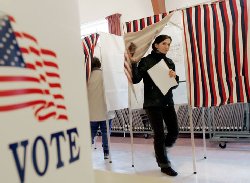 In 1835, noted historian and political commentator Alexis de Tocqueville, a Frenchman, published his famous book, "Democracy in America," which was an analysis of our young country as compared to those in Europe. This was based on his travels through America in 1831 and 1832. The book, which is frequently referenced even to this day, contains his observations on the young country, everything from its geographical layout, to its culture, and particularly its new political system as a democratically elected republic as opposed to a monarchy.
Tocqueville was particularly taken by the American public education system. He was amazed to see children as young as second grade be completely literate, something normally reserved for the aristocracy in Europe. He was also taken by how knowledgeable children were in the workings of the government as defined by the U.S. Constitution. He wrote, "It cannot be doubted that, in the United States, the instruction of the people powerfully contributes to the support of a democratic republic;"
When you compare the America of the early 19th century to today, you will find students, even college graduates, who have no sense of history, no sense of the mechanics of our government at any level, and no sense of current events. Somehow we dropped the ball along the way. We now have a couple of generations of Americans who are content to limp along as apathetic sheeple. The second graders of the 1830's are mental giants by comparison. Not surprising, the politicians of today appeal to the voters through emotion rather than logic. It has become too easy to deceive and misdirect the under informed public.
However, for those who want to get back on track, to learn about the government and current events, there are plenty of resources available.
1. Discuss - learn to discuss such subjects with your family, friends and colleagues, but be careful, political discussion can lead to arguments and disrupt harmony. If you can find such people though interested in participating in discussions, it can make for some interesting mental gymnastics.
In schools, it would be nice to see government and history courses reintroduced, and, No, not just from the 20th century forward. How about the 18th or 17th centuries instead?
Understand your rights as a citizen and the the mechanics of government by becoming familiar with our governing docs.
Two books come to mind which can help:
"The 5000 Year Leap" by W. Cleon Skousen, is an excellent primer to describe why our government is organized the way it is. As far as I'm concerned, this should be on the reading list for every high school student.
For those who wish to be a little more ambitious, let me suggest Tocqueville's "Democracy in America," which provides interesting insight as to the differences between the United States and the rest of the world. The book is rather thick, but stimulating nevertheless.
Learn to read and watch the news. More importantly, challenge the accuracy of the news and beware of newscasters trying to spin it.
2. Write - Want to do more? How about writing your Congressman? Whether you voted for them or not, these people are charged to represent you. Do not hesitate to ask questions or discuss your views on certain subjects. Remember, they work for you, not the other way around. You can also write the President of your concerns. Also learn to contact your local and state officials.
While you're at it, post your views in your local newspapers in the "Letters to the Editor" section.
You may also wish to contact the various political parties to pose a question or comment, such as the Democratic Party, the Republican Party, or the Libertarian Party.
Linking to such political and news organizations via social media outlets, such as Twitter and Facebook, is also a good way of staying abreast of news stories, and opinions.
3. Activism - finally, volunteer your time in various political and nonprofit organizations, thereby allowing you to rub elbows with people of similar interests and help push forward those items you feel are important. As we approach the mid-term elections, and you are interested in party politics, you may want to hold a sign or walk a neighborhood in support or your favorite politician or cause. Just remember to maintain your composure, especially when doors are closed in your face.
As Tocqueville suggests, citizens have an implicit civic responsibility to become educated in the workings of government and to maintain a sense of history. Becoming a sheeple is not conducive for improving government.
Keep the Faith!
Note: All trademarks both marked and unmarked belong to their respective companies.
 Tim Bryce is a writer and the Managing Director of M&JB Investment Company (M&JB) of Palm Harbor, Florida and has over 40 years of experience in the management consulting field. He can be reached at timb001@phmainstreet.com
For Tim's columns, see: timbryce.com
Like the article? TELL A FRIEND.
Copyright © 2017 by Tim Bryce. All rights reserved.
Also read Tim's columns in the THE HUFFINGTON POST
NEXT UP: ARE WE BECOMING A GODLESS COUNTRY? - What the "separation of church and state" really means.
LAST TIME: THE MYTH OF EQUALITY - More than anything, equality is about ego.
Listen to Tim on WZIG-FM (104.1) in Palm Harbor,FL; KIT-AM (1280) in Yakima, Washington "The Morning News" with hosts Dave Ettl & Lance Tormey (weekdays. 6:00-9:00am Pacific). Or tune-in to Tim's channel on YouTube. Click for TIM'S LIBRARY OF AUDIO CLIPS.


 The Declaration of Independence tells us that all men are created equal, but we sure don't want to be treated as such when we get older. Americans steadfastly and openly proclaim their belief in the concept of equality, yet adamantly refuse to be treated in this manner. Equality, therefore, is an American myth and one reason why we tend to act more like stubborn individualists as opposed to team players. Being treated equally and fairly sounds nice, but it's a matter of who knows who, and what we can do for each other (aka, "Politics 101").
 One of my favorite quotes from Albert Einstein is his definition of insanity: "doing the same thing over and over again and expecting different results." I'm afraid we see this too often, be it in companies, government or the general public. In other words, there is a tendency for people to maintain the status quo even if it doesn't produce beneficial results, or even if it is counter productive.
 These are troubling times. We have Islamic terrorists who would like nothing better than to snuff out the rest of the world. We have a tin-horn dictator in North Korea with access to nuclear devices. And we have other crackpot third world regimes thirsty for power and enslave their people. At home, we have two diametrically opposed ideologies at each other's throats, with no room for compromise. It occurred to me recently we have been hearing these same stories day after day for quite some time now.
 While I was driving home one night, I was stopped at a traffic light and began to imagine what life would be like without the many electronic conveniences we enjoy. Hmm...
 Back in the 1980's a generation of young MBA's were unleashed on the corporate world and turned it on its ear. These "whiz kids" slashed costs wherever possible, particularly in training programs, mentoring, and reduced administrative personnel. Although their tactics did indeed save money in the short run, they created long-term headaches down the road, such as creating morale problems which lead to a disconnect between workers and their employers, which ultimately lead to outsourcing many jobs overseas. Quality in manufactured goods and services also suffered as a result of less training. Whereas employees had previously been empowered to overcome problems under a spirit of teamwork, managers began to closely supervise workers which today is commonly referred to as "micromanagement." The point is, the whiz kids of the day made a name for themselves simply by implementing short term changes which were highly visible on the next quarterly P&L statement. Although they could show short-term benefits rather quickly, their bean counter approach had devastating long-term effects on many businesses which haunted companies for years.
 According to recent polls, the news media has been taking a pounding in terms of losing credibility with the American public. People no longer trust the press as they see it as nothing more than a cog in an ideology machine as opposed to a trustworthy source of unbiased information. From this, the concept of "fake News" has emerged, causing people to look for news from other outlets, such as social media, which is also not necessarily the most reliable.