
Search This Blog

Sunday, January 30, 2011

INSTANT KARMA'S GONNA GET YOU

I shot out a traffic light the other day with my shotgun, one that has been giving me fits lately as I go to work. No, I didn't actually shoot it, but I have found myself fantasizing about doing so lately as I have become increasingly agitated while waiting on this particular light. In fact, I've noticed I'm becoming more irritable lately and have even found myself yelling expletives at machines, particularly my computer and cell phone. No, I don't think I'm going through a change of life. Heck, I wouldn't even know what a hot flash was, but I don't think I'm alone. When I mention this to my friends, they recognize their level of impatience is rising as well. I have older friends who are retired and appear much less stressed out and this got me thinking as to what was the cause of the discrepancy. True, I am still actively employed and they are not, but this is as it has always been. There must be something else.

Other than being employed, I am much more imbued with technology than my predecessors. For example, I make extensive use of computers on a daily basis. I write and communicate with them, I prepare presentations and spreadsheets, develop and use data bases and web pages, process financial transactions, and I use them for entertainment purposes. I have a cell phone which I use only occasionally, unlike a lot of people who seem to be addicted to them. My children are probably more proficient with such devices than I am, not to mention games and digital multimedia. Then it hit me; through our technology we have been nurturing a sense of instant gratification thereby affecting our tolerance.

Take photography as a small example. Just fifty years ago you would have a simple box camera where you carefully loaded a roll of film, usually consisting of just 12 shots (exposures). After you took your "snapshots" you would take the film to a drug store to be processed at a price and normally requiring a couple of days. 35mm cameras slowly made their way into our lives offering superior pictures with a roll of 36 shots. Nonetheless you would still have to wait to have the film processed. The point is, because you had limited exposures which cost you money to process, you tended to be more judicious in taking a photograph which was normally used for special occasions, such as group shots at birthdays, anniversaries, reunions, etc. or to capture memories while on vacation. Today it's different. You would be hard pressed to find anyone without ready access to a digital camera of some kind (the cell phone took care of that). Now we expect to take voluminous instant pictures and upload them to the Internet for sharing with family and friends. Whereas fifty years ago, the average family may have taken no more than 100 pictures in a year, today we take thousands and distribute them around the world instantly. And if we cannot, we become terribly upset.

This leads me to believe there has been a significant change in our dispositions due to our enhanced use of technology. It would be interesting to see some research substantiating how our tolerance levels have changed over the years, thereby leading to heightened stress in our society. Technology has dramatically altered how we access news, our eating and sleeping habits, even how we learn which, in turn, affects our mental acuity, such as our alertness, our attention span and our sense of work ethic.

Technology has conditioned us to be intolerant of inefficiencies and limitations thereby causing us to think faster, virtually, and to multitask. Think about it; we don't like to wait in traffic, we expect to be able to call and talk to any person anytime we want, we want information at our fingertips, we expect to be able to listen to any song or watch any movie whenever we're in the mood, we want to get in and out of hospitals, we want instant food, instant pictures, instant credit, instant money, instant everything. We drive faster and talk faster because we have been conditioned to do so. The pace of business has also picked up considerably because it is driven by technology. We want things to be built faster and cheaper, and have no patience for anything less.

When John Lennon wrote his song "Instant Karma!" he was poking fun at our inclination to want everything instantly, that we didn't want to work hard for anything, such as instant coffee, instant food, etc. Since he wrote the song in 1970 there have been sweeping changes to technology beyond what Lennon could have imagined as we have developed an unforeseen addiction to it.

Our sense of instant gratification today causes us to throw childlike tantrums when we cannot get something on demand. Waiting is one thing, our tolerance level is another. I contend our personalities are being subliminally distorted by technology. We obviously want everything faster, cheaper and better, but is it possible that too much communications is a bad thing? Or too much entertainment, or too much information? If it distorts our culture negatively, the answer is, Yes.

There is a certain amount of Parkinson's Law being applied here. For example, video games used to be nothing more than tic-tac-toe, then PacMan was introduced, both of which were amusing but rather lethargic by today's standards. Now we have realistic video graphics featuring blood and guts that move at warp speed and teaching questionable ethics. As the pace of video games increased, so did our pulse.

I find one of the biggest differences between my generation and my older retired friends is we no longer know how to enjoy the moment. We are constantly pushing ourselves to move aggressively faster. Not enough people are finding time to unplug and decompress, and, No, collapsing in front of the boob tube at night is not the answer. Activities such as reading, attending civic events, art, exercise, sightseeing, fishing, etc. offer a distraction that a lot of us need to regain our composure. In other words, there is nothing wrong with occasionally stopping to smell the roses.

If things are this hectic early in the 21st century, imagine what we'll be like by the 22nd. We already see signs of change in our youth who want everything now and as painlessly as possible thereby creating a sense of entitlement. Older people have trouble understanding why youth no longer has the drive and desire to earn things. The answer is rather obvious; they've been conditioned to think this way. It would be interesting to see what would happen if the plug was suddenly pulled from our technology. People would probably go through withdrawal symptoms before finding it necessary to think for themselves again, to learn to cooperate, communicate, socialize, and all of the other people related skills that have been altered over the years. It would actually be quite fascinating, but, of course, this will never happen.

Finally, consider these lyrics from Lennon's "Instant Karma!" -

Instant Karma's gonna get you
Gonna knock you right in the head
You better get yourself together
Pretty soon you're gonna be dead

What in the world you thinking of?
Laughing in the face of love
What on Earth you tryin to do?
It's up to you, yeah, you

Instant Karma's gonna get you
Gonna knock you right in the face
You better get yourself together darling
Join the human race

Keep the Faith!

Note: All trademarks both marked and unmarked belong to their respective companies.

Tim Bryce is a writer and the Managing Director of M. Bryce & Associates (MBA) of Palm Harbor, Florida and has over 30 years of experience in the management consulting field. He can be reached at timb001@phmainstreet.com

For Tim's columns, see:
http://www.phmainstreet.com/timbryce.htm

Like the article? TELL A FRIEND.

Tune into Tim's THE BRYCE IS RIGHT! podcast Mondays-Fridays, 11:30am (Eastern).

Copyright © 2011 by Tim Bryce. All rights reserved.

Thursday, January 27, 2011

JURY DUTY: A NECESSARY EVIL

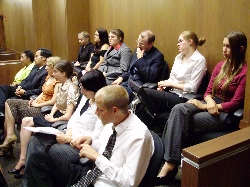
I've been summoned for jury duty twice. Both times I had mixed emotions about serving. On the one hand I understand and appreciate the need for a jury of your peers, which I consider an important responsibility for being a citizen of the United States. There are still a lot of third world countries out there who do not provide for such jurisprudence and believe you are guilty until proven innocent, as opposed to the other way around. On the other hand though, we are always summoned at the worst possible time. For example, you are called to serve just as you are preparing to go out of town either on important business or an expensive nonrefundable vacation. I think it's a "Murphy's Law." In my case, I had some important projects I was working on at the time and felt the summons to be an imposition. Although I dutifully presented myself, I was not in the best of moods. Fortunately I was never actually selected to a jury and allowed to leave. Good thing for the defendant too as I was in a hanging mood by the time I got to the court house.
Here in Florida, you are given a few weeks notice to appear for jury duty. Frankly, I would prefer to get a notice six months or more in advance so I can effectively schedule around the jury duty. Unfortunately, county bureaucrats couldn't care less about a person's time.
Down here in Florida, you can be compensated $15.00 per day for the first three days of service if you are retired, unemployed or your employer does not pay your regular wages while you are serving. It's not that I personally need the money, but I don't know too many people who can get along on just $15 per day. A daily bus pass in my county costs $4.50, leaving you $10.50 to go wild on. No wonder people begin to diet when they are summoned for jury duty. By the way, your jury payment is considered taxable income. You just can't win.
There is a lot of "hurry up and wait" involved with serving on a jury. In my neck of the woods, you are first asked to check in, take a number, fill out a form, and wait in a holding pen where you watch a brief video on your responsibilities as a juror. Next, you are called from the pool by ticket number for the various cases on the docket that day. If your number is not called, you can go home (with no apology for the inconvenience). However, if your number is called, you must go through a jury selection process whereby you may be interviewed by counsels for both the prosecution and defense. In my case, I was asked a lot of strange questions about this or that. So much so, I thought I was the one on trial and not the defendant. Whatever I said, I must have answered incorrectly as I was excused from serving, again with no apology for the inconvenience.
I believe my grandmother in Buffalo, New York set a record for serving on juries as she was called at least a dozen times over the years, leading us to believe she worked for the courts up there and not her regular job. Actually she was a model jurist and enjoyed listening to the various cases. She was also proud to serve as she saw it as her civic duty to do so.
We would all probably like to serve on the types of juries we see on TV's "Law & Order" where we are dazzled by lawyers like Jack McCoy, or perhaps pick an argument apart as the jury did in the movie, "Twelve Angry Men." The reality though is most trials lack the drama and histrionics as portrayed by Hollywood. You are probably 100 times more likely to serve on a case involving theft or an automobile moving violation than to serve on a juicy murder trial.
Most people tend to roll their eyes whenever you bring up the subject of jury duty, including myself. I wish I had my grandmother's zeal for serving, but the bureaucrats have turned it into an imposition as opposed to something you want to proudly perform. I guess no matter how you slice it, jury duty is a necessary evil.
Keep the Faith!
Note: All trademarks both marked and unmarked belong to their respective companies.

Tim Bryce is a writer and the Managing Director of M. Bryce & Associates (MBA) of Palm Harbor, Florida and has over 30 years of experience in the management consulting field. He can be reached at timb001@phmainstreet.com
Like the article? TELL A FRIEND.
Tune into Tim's THE BRYCE IS RIGHT! podcast Mondays-Fridays, 11:30am (Eastern).

Copyright © 2011 by Tim Bryce. All rights reserved.

Wednesday, January 26, 2011

INSUBORDINATION

Over the years, I believe I've seen just about every type of organizational structure in the corporate world, be it the traditional hierarchy, matrix, project teams, etc. No matter how you slice it though, unless you are the top dog, there is always going to be at least one person you have to report to, someone who is ultimately responsible for authorizing your paycheck. Even the top dog has to report to someone, such as shareholders. Regardless of who you report to, you owe your allegiance to your superior. If you don't like the person, request a transfer or take another job elsewhere. I'm old-school in this regard; as long as you are in the person's employment, do not malign him or ridicule him, come to his defense instead. Loyalty is a rare commodity these days, particularly due to obnoxious micromanagement and rocky economics, but you have to realize your success ultimately depends on your superior's success. Believe me, if he is struggling, you're next. You can make all the unflattering remarks you want about your boss after you have left. In the meantime, you owe him your support.
All of this, of course, means you should follow his orders and rules. In the military, you will be expected to do so without questioning your superior's rationale. In the corporate world, it's a little different. Hopefully, your boss will clue you in as to why something is needed, but it is not mandatory for him to do so. There will be some bosses who will bark at you, "Jump!" to which you are to reply, "How high?" If this is what you signed up for, you better be ready to do so, otherwise you would be wise to move along to something else.
It is hard to maintain your allegiance to someone who is either your junior, creepy, or you plain and simply do not respect. There will also be instances of personality conflicts where you and the other person see the world differently. Again, until such time as you move along, you should respect the wishes of your superior. This doesn't mean you have to love him or kiss his behind, even though he may want you to do so. It means you should conduct your business as professionally as possible while respecting his authority.
When you are applying for a job, you should try to size up the person you are about to work for. What is his management style? What are his ethics? What type of corporate culture does he promote? Will you be able to effectively perform your duties and responsibilities for this person and in this environment? Good or bad, you better know the answers before you accept the job.
Is there ever a time when it is appropriate to be insubordinate? Yes. Even the military realizes there will be unusual circumstances when it is necessary to contradict your superior. Actually, there is not too much difference between the corporate world and the military in this regard. Two specific areas come to mind: ethics violations and a major mistake. It is hoped, your organization has a code of conduct and/or a policy manual. If not, common sense and the laws of the land will dictate what is right or wrong. Either way, if your superior orders you to violate the ethical rules of the business, such as cheating a customer or misrepresenting the company, it is not only your right to become insubordinate, it is your duty. The same is true of a major blunder. For example, if you are about to execute a contract for $2,000, yet it was intended to be $200,000 (where someone misplaced a few zeros along the way) your boss may become embarrassed if you correct him thereby showing your insubordination to him), but he should thank you later nevertheless. If possible, override your superior with tact and diplomacy so he doesn't lose face, but occasionally tempers will flare and you may very well have to apologize for your actions.
If you feel you have been unfairly treated for your insubordination, you may want to go to someone higher in the chain of command. Human Resource departments may also have an ombudsman of some kind to handle such situations and reconcile differences. Either way, it is a smart move to document the insubordination incident as precisely as possible. As soon as possible, write your interpretation of events and, if possible, review it with witnesses for accuracy. Understand this, in all likelihood, your boss is going to be asked to do the same thing by the HR Department.
Insubordination is an ugly affair that rarely benefits anyone. The best thing to do is try to remain loyal to your boss and go about your business the best you can. If you are truly unhappy, try to move along and find something else. True, your boss may be a problem, but it may also be you as well. Do some serious soul-searching before you make a mistake.
Loyalty, dedication and professionalism are rare commodities these days, particularly in the cutthroat world of corporate America. Regardless, when you find someone you believe in, do not hesitate to stand by him through thick and thin. In all likelihood, it will be reciprocated, even if you have nothing else in common with your boss. A good manager understands hard work, but he doesn't forget loyalty.
Keep the Faith!
Note: All trademarks both marked and unmarked belong to their respective companies.
Tim Bryce is a writer and the Managing Director of M. Bryce & Associates (MBA) of Palm Harbor, Florida and has over 30 years of experience in the management consulting field. He can be reached at timb001@phmainstreet.com
Like the article? TELL A FRIEND.
Tune into Tim's THE BRYCE IS RIGHT! podcast Mondays-Fridays, 11:30am (Eastern).

Copyright © 2011 by Tim Bryce. All rights reserved.

Monday, January 24, 2011

GOBBLEDYGOOK

I always liked the word "gobbledygook" ever since I first heard it in my High School English class. If memory serves me correctly, the term resulted from World War II to combat bureaucratic processes that impeded progress in the war plants. Basically, it refers to unclear or wordy jargon that is more inclined to confuse than to clarify something. It seems to me there is an abundance of gobbledygook in our daily vernacular. Let me give you a few examples of such expressions that particularly tests my patience.
The term "workaround" has been popular for at least the last ten years and I believe it was derived from the Information Technology (I.T.) sector. I tried looking it up in both Webster's and The New Heritage Dictionary and, of course, I couldn't find it. As we all know, it has come to mean finding a way around a technical problem. It doesn't mean it's a correction to a problem but rather, a way of addressing a problem. Make no mistake though, "workarounds" ultimately represent errors or "bugs" in the system and we should refer to them as such. I'm amazed by programmers when they proudly proclaim they've found a "workaround" as opposed to admitting they have a problem and don't know how to fix it.
An I.T. Department should avoid the term "workaround" as it tends to irritate end-users and causes them to lose faith in the development staff's ability for solving their problems. An error is an error, I don't care what you call it; don't try to sugarcoat it, fix it.
As an aside, I was finally able to find "workaround" defined in the Redneck Dictionary. It's typically used to determine the location of employees. For example, "Hey, Y'all workaround here?"
Next, we have the word "guestimate." I have been involved in the systems industry for a long time and have taught Project Management for the past three decades. I have always found it unsettling how people try to invent new words in an attempt to appear cute and clever. "Guestimate" is such a word which implies an estimate is simply a guess, to which I have to give a great big "DUH." Estimating is fundamentally an effort at projecting the future. Like all projections, the more facts and information available, the better the estimate will be, but rarely is it ever perfect. There is a natural human tendency to avoid making estimates because estimates are expressions of commitments, and people tend to shy away from commitments and accountability, particularly when they are not sure of the facts. Look, let's keep it simple, an estimate is an estimate and a guess is a guess, let's not create any more 3rd grade words such as "guestimate."
Another word that bothers me is "reiterate" and you hear it just about everywhere these days. Think about it; what does it mean? The word "iterate" refers to the repetition of something. So what do we mean when we say "RE-iterate"? An infinite loop? Our language is sloppy enough without us having to produce new words to dilute old ones, but I guestimate I am reiterating myself.
There is an old expression which I have been hearing a lot in our vernacular these days, and that is "Let me be honest with you." I personally know a lot of people that use this expression and frankly, its getting old. When a person says it, I come away thinking he has been dishonest with me all other times.
As creatures of habit, we tend to be repetitive in our speech. I have also heard expressions like "At the end of the day" and "Frankly" (which I am also guilty of using myself). Excessive use of expressions and buzzwords tend to be very distracting in a conversation and doesn't serve the speaker well. "But frankly, at the end of the day, we have to be honest with each other." See what I mean?
I hear America talking, but I don't like what I'm hearing. Our language is sloppy and convoluted, or should I say filled with "gobbledygook"? It makes you wonder how people from foreign countries ever learn our language and understand us. We can't even understand ourselves.
One last note: The word "often" is pronounced with the "t" silent ("off-en"), not "off-ten" - Look it up.
Keep the Faith!
Note: All trademarks both marked and unmarked belong to their respective companies.
Tim Bryce is a writer and the Managing Director of M. Bryce & Associates (MBA) of Palm Harbor, Florida and has over 30 years of experience in the management consulting field. He can be reached at timb001@phmainstreet.com
Like the article? TELL A FRIEND.
Tune into Tim's THE BRYCE IS RIGHT! podcast Mondays-Fridays, 11:30am (Eastern).

Copyright © 2011 by Tim Bryce. All rights reserved.
Thursday, January 20, 2011

DOG TREATS

My mom has two miniature dachshunds whom she is very attached to. Like a lot of dog owners, she pampers them and frankly, I think they lead a very comfortable existence. It's a good gig. All they have to do is return her love and try not to soil the carpet too often. Other than that, she dotes on them as if they were her own children. They have comfortable beds to sleep in, plenty of toys and chew sticks to occupy their time, they can play in a fenced-in yard, and have homemade dinners prepared for their finicky tastes. I would probably sign up for such a program myself, but I fear my testicles would be sacrificed like the dogs did.

You may remember me talking about the German Shepherds we had when I was younger. Back then, all we fed them was some Purina Dog Chow mixed with a can of Ken-L Ration. Sometimes we would add a raw egg to give their coat a shine. If they were lucky they might get some leftover table scraps, but we were careful not to overindulge them. If they were really lucky, we would give them a Milk Bone which was one of the few treats available at the time. The dogs would have to earn the treat by performing some sort of trick, such as sitting up on their back paws, barking on command, or balancing the treat on their nose. They were quite good at entertaining us. However, this didn't hold up over the years, and today the dachshunds have turned the tables on my mom where she is now trained to give them treats on command.

The dachshunds don't eat Milk Bones either. The times have changed and I am amazed by the variety of dog treats available today. I guess Milk Bones are no longer considered acceptable for the discriminating tastes of dogs. Huh? There is now a wide selection of "softer" and more meatier treats. For example, there are treats shaped liked miniature porterhouse steaks (complete with bone), dog pepperoni sticks, bacon shaped strips, drumsticks, sausages, etc., all in a variety of flavors such as beef, cheese, bacon, and there is even one claiming a filet mignon taste. All very appetizing.

This got me thinking, how do we truly know these treats taste as they claim? In examining the ingredients of these products, I noticed most consist of such things as chicken by-product meal, liver, animal fat, and dried cheese product. I'm not sure how you produce a "filet mignon" flavor from this. I never liked liver, yet this seems to be one of the main ingredients and I suspect effects the taste. But how do we know, in fact, something tastes as they're advertised? The animals are certainly not going to tell us. So, there must be some poor slob out there actually taste-testing these products and giving their stamp of approval, but I don't think this is a job I would volunteer for.

It is my guess these dog treats actually all taste the same and are just stamped out to form different meaty shapes. I also believe the so-called "flavors" are designed to appeal more to the owners as opposed to the pets themselves. After all, I can't remember the last time a dog said to its owner, "Yea, pick me up a bag of the pepperoni sticks, and don't forget the nacho cheese."

Ah, the life of a dog.

Keep the Faith!

Note: All trademarks both marked and unmarked belong to their respective companies.

Tim Bryce is a writer and the Managing Director of M. Bryce & Associates (MBA) of Palm Harbor, Florida and has over 30 years of experience in the management consulting field. He can be reached at timb001@phmainstreet.com

For Tim's columns, see:
http://www.phmainstreet.com/timbryce.htm

Like the article? TELL A FRIEND.

Tune into Tim's THE BRYCE IS RIGHT! podcast Mondays-Fridays, 11:30am (Eastern).

Copyright © 2011 by Tim Bryce. All rights reserved.

Tuesday, January 18, 2011

HERDOPHOBIA

Recently I diagnosed myself as suffering from an acute case of Herdophobia, an anxiety disorder related to being amongst too many people. Actually, I think I have been suffering from it for quite some time now. Only recently did I start looking into it after taking an ocean cruise over the holidays. Our ship was one of the larger ones which held approximately 2,500 passengers. Although there were mostly Americans on board, there were a lot of other cultures represented including China, Japan, Western Europe, and several Spanish speaking countries. It was most definitely a heterogeneous environment. Despite their cultural differences, most of the passengers appeared to get along harmoniously as long as they were supervised by the ship's crew. However, when they were turned loose under their own accord, bedlam ensued as people came down with a bad case of the stupids. At least that was my perspective of the situation.
Wanting to know more about my problem, I checked medical resources on the Internet. I read about such things as Enochlophobia, Demophobia, and Agoraphobia, all of which relate to the fear of crowds. In all cases though, the descriptions seemed to miss the mark as to my concerns. They talked about panic attacks related to escaping from confined areas, fear of being trampled or crushed, not being able to breath, or to perhaps contract a disease. Nope, none of this described my ailment, therefore I invented my own, Herdophobia.

The premise behind Herdophobia is simple, people tend to act like herds of animals in group settings. Herds obviously need to be supervised and controlled or you run the risk of creating a stampede thereby inflicting damage. We see herd behavior at beaches, sporting events, carnivals and open-air events, in traffic, and in my case, on cruise ships. As intelligent as we would like to believe we are, the human animal must be carefully organized and supervised in group settings. If unchaperoned and left to their own inclinations, helter skelter inevitably ensues and this is what lies at the root of my fear; chaos.

I tend to believe our greatest invention was not the wheel, as is popularly believed, but rather the line, whereby we are organized into a sequential process where everyone must take their fair turn. We see lines in banks, government offices, check out counters, painted on our highways, even the pews in churches are designed to keep people in order. We have been conditioned to behave better under such organization. Without lines, we do as we please and do not hesitate to step on the toes of others.

On the cruise ship, there was a large cafeteria style restaurant on board where you could get something to eat morning, noon, or night. Breakfast and dinners weren't too much of a problem as most of the passengers were sleeping-in during the morning and eating in the main dining halls in the evening. Lunch was madness though. This particular cafeteria featured many islands specializing in different foods, such as pizza and pasta at one island, burgers at another, salads and soups at another, etc. Consequently, passengers would bounce from one island to another to pick up whatever food items pleased them. This bouncing effect caused people to run into each other frequently and instead of apologizing, they would grumble an unpleasantry even if they were the cause of the problem. There was no organization, no decorum, no supervision, and no manners whatsoever, a sort of dog-eat-dog environment, thereby turning what should have been a pleasant experience into a nightmare. It was at this point I became aware of my Herdophobia.

I am occasionally accused of being a control freak which may contribute to my anxiety, and there probably is a certain amount of truth to this. I do appreciate the need for such things as organization, punctuality, discipline, and cleanliness. I also disdain procrastination and lack of direction (I tend to subscribe to the school of "lead, follow, or get the heck out of the way"). More importantly though, I have little tolerance for rude behavior in large group settings, regardless of the culture you come from. A little patience, courtesy, such as "please" and "thank you," and consideration for others in a group setting goes a long way with me. Unfortunately, I didn't see anything remotely like this in the cafeteria, hence my Herdophobia flare up. My fear was not of entrapment, but of punching someone deservedly in the nose for running into me or cutting in front of me with no apology.

Humans are supposed to be the "intelligent animal," who can apply logic and reason to solving problems, to express their creativity, and love thy neighbor. In large group settings though, the monkey gets the nod over man in the brains department.

Yes, I am Herdophobic, but I do not believe it is a true character flaw. Admitting you have a problem though is the first step towards conquering it. In the meantime, you would be wise to stay out of my way at the next public gathering.

Keep the Faith!

Note: All trademarks both marked and unmarked belong to their respective companies.

Tim Bryce is a writer and the Managing Director of M. Bryce & Associates (MBA) of Palm Harbor, Florida and has over 30 years of experience in the management consulting field. He can be reached at timb001@phmainstreet.com

For Tim's columns, see:
http://www.phmainstreet.com/timbryce.htm

Like the article? TELL A FRIEND.

Tune into Tim's THE BRYCE IS RIGHT! podcast Mondays-Fridays, 11:30am (Eastern).

Copyright © 2011 by Tim Bryce. All rights reserved.

Monday, January 17, 2011

HAVING A BAD DAY

When I come home at night after work, my wife and I typically talk about what we did that day. My wife gives me a journal description of her day from the time she got up until we finally meet at night. She's quite articulate in her adventures of the day which may explain why she looks puzzled at me when she asks me how my day went and I respond by saying simply "Fine" or "Good." Actually, I have a "Bad" day now and then, but not too often. I usually have but one a year, and I don't mean a type of day where you run into some problems at work or a key decision doesn't go your way. I'm talking about a day where everything consistently unravels before your eyes and you are powerless to do anything about it. Maybe a better adjective would be a "Rotten" day. I had one a couple of weeks ago thereby ruining my day.
It began on a cold Wednesday here in Florida, which may sound like an oxymoron, but on this particular occasion a cold Arctic blast came down from Canada. We may have not gotten the snow or frigid temperatures that the Midwest received, but getting into the 30's is still cold by my estimate. As I was leaving for lunch I noticed my car had a flat tire on the left-rear side. "Oh, great," I lamented to myself.
A friend who happened to know my local mechanic mentioned he had an air can containing compressed air which may be able to inflate the tire long enough for me to drive it into the shop where it could be fixed. This sounded like a good idea, so he drove down and retrieved the can for me. The can was rather old and strange looking. Actually, it looked like a rusted and overgrown Jiffy Pop machine turned on its side and built around the time of the first World War. I had visions of Dough Boys using it in the Battle of the Marne to fill their gas masks. Nevertheless, I took the Jiffy Pop machine and hooked its hose to my tire stem. "Pffffst" and only a small puff of air came out of it before it died. I think I should have given it a military funeral in my dumpster right then and there.
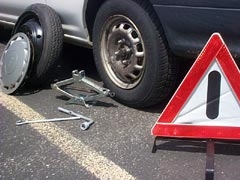
I then resigned myself to the fact I would have to change the tire myself with the spare I had in the trunk. Now most people would call AAA or a local service station, but my masculine ego kicked into gear and I was determined to do it myself. After all, I had changed many tires over the years, "What is one more tire?" I said to myself. Unfortunately, I had never changed a tire on this particular vehicle, a Kia from South Korea. Dutifully I took out the tools packaged neatly in the trunk. So far, so good. There was a screwdriver and wrench, as well as a jack and tire iron. However, calling it a "tire iron" would be overly generous. It looked more like an overgrown silver Pixie Stick, approximately ten inches in length.
Before you jack-up a car to remove a tire, it is a smart idea to first loosen the lugnuts. I used the Kia screwdriver to remove the plastic lugnut cover from the wheel, a feat in itself as it stubbornly did not want to come off. I then took the Pixie Stick and tried to turn the lugnuts much to no avail, they were on simply too tight. It was about this time that I noticed sweat developing on my forehead and removed my jacket as I was becoming too warm even in the cold weather. After fifteen minutes of pushing and bending the Pixie Stick (which included some choice expletives on my part), I concluded this was a futile effort. Still determined to see this job through to completion, I borrowed a car and drove home to get an industrial strength tire iron I had in my garage. My house is only five miles from the office, but it wasn't until I was halfway home when I realized I left my house key in my jacket back at the office. Not surprising, there were more expletives.
I turned around and returned to the office where I picked up my keys and headed for home again where I performed a frantic search for the tire iron in the garage. It was, of course, in the last possible place to be found in the garage but I was pleased nonetheless that I had found it. I then drove back to the office where I applied my tire iron to the lugnuts. Even with the considerable leverage afforded me by my tire iron, the lugnuts openly resisted my attempts to loosen them. By this time, I noticed my shirt was no longer tucked in my pants which were now drooping as I was bouncing up and down next to the tire like a pogo stick. Just when I was convinced the people at Kia had welded the lugnuts on to the wheel they finally started to loosen with a rusty squeak. One-by-one, squeak-by-squeak, lugnut-by-lugnut, curse-by-curse, they finally surrendered to me.
With the lugnuts loosened, I then went about positioning the jack under the car to raise the vehicle. Actually, it looked more like a toy than a jack. Years ago, cars came with jacks that were made of big hunks of steel you used to raise the vehicle, and it was actually fun to do so. My Kia jack though was no bigger than my two hands put together and was based on a screw mechanism which came with another Pixie Stick to turn the screw. This required me to use my first Pixie Stick tire iron to turn the other. Since the two were so small, I found myself kneeling on the ground spinning the two Pixie Sticks like you were rapidly peddling a bicycle. I'm sure it was quite comical to watch. Slowly but surely, the jack raised the car up until I could replace the old tire with my spare. I then lowered the car and tightened the lugnuts.
Afterwards I got back on my feet, straightened myself up and was sharply reminded of the arthritis cultivating in my back. I was sweating, my clothes a mess, and my hands soiled with tire filth. Did I mention it was still freezing outside?
After cleaning myself up, I put the tools away properly in the trunk, along with the flat tire and the Jiffy Pop air can from World War I. Finally, I drove my car to my mechanic's shop to drop off the air can and have him replace the tire. Elapsed time: two hours, not to mention my afternoon was shot down as it took me some time to regain my composure. The experience: priceless.
The lesson here is that you should always carry a proper set of tools in your car, have a change of clothing, and wait for proper weather conditions to change a tire. Either that or lose the ego and call a mechanic.
As mentioned, I don't experience "Bad" days often, but when I do it has been my observation they are defined by the domino effect that takes place whereby a series of interrelated screw-ups cascade from one to another. Such events are incredibly frustrating thereby testing your patience.
When I got home that evening, my wife as usual asked me how my day went. I answered "Fine" as I didn't want to see the dominoes progress any further.
Keep the Faith!
Note: All trademarks both marked and unmarked belong to their respective companies.
Tim Bryce is a writer and the Managing Director of M. Bryce & Associates (MBA) of Palm Harbor, Florida and has over 30 years of experience in the management consulting field. He can be reached at timb001@phmainstreet.com
Like the article? TELL A FRIEND.
Tune into Tim's THE BRYCE IS RIGHT! podcast Mondays-Fridays, 11:30am (Eastern).

Copyright © 2011 by Tim Bryce. All rights reserved.