Search This Blog

Wednesday, February 4, 2015

A PLEDGE TO DENOUNCE TERRORISM

BRYCE ON TERRORISM

- Who is ready to sign the pledge? I know I am.

(Click for AUDIO VERSION)
To use this segment in a Radio broadcast or Podcast, send TIM a request.

White House Press Secretary Josh Earnest recently announced the Obama administration will host a Summit on Countering Violent Extremism on February 18th. The summit will highlight domestic and international efforts to prevent violent extremist activities and terrorism. This will likely be used to discuss cooperation between countries regarding sharing intelligence and responsive action. However, it will probably not deal with the matter of detecting terrorist sympathies or creating a movement to quell such activity.

On January 11th, the French held their Solidarity Rally in Paris to protest the bloody attack of the French satirical newspaper Charlie Hebdo by Islamic extremists. The rally was a symbolic gesture which highlighted the growing disgust and anger by the people of the world regarding terrorism. Smaller rallies were held elsewhere, including Germany where Muslims rallied to show solidarity with Paris. To capitalize on this sentiment, perhaps we can do more.

Up to now, the Muslim community has been reluctant to criticize Islamic terrorism, partly due to fear and partly due to sharing the sentiments of the extremists. I have always believed the Muslim problem is a Muslim problem, meaning it is ultimately up to the Islamic faithful to get their extremists under control. This can begin by publicly denouncing terrorism as in the German rally. Following Paris, Ahmed Aboutaleb, the Muslim mayor of Rotterdam, the Netherlands, recently raised eyebrows in an interview where he was quoted as saying to Dutch Muslims, "If you can't find your place in the Netherlands, in the way we want to build a society together, leave."

Actually we need more calls to refute terrorism, be it from Muslims, Christians, Jews, or whatever your faith happens to be, or even if you do not believe. As a Christian, I readily denounce any terrorist activity related to my faith, as should Muslims, Jews, etc. Frankly, I have had enough and it's time to soundly denounce such behavior. To this end, imagine if Americans were all asked to sign a pledge publicly denouncing terrorism. Such public condemnation can only have positive effects. However, if people refused to sign it, they would be admitting their sympathies to terrorists and, as the Rotterdam Mayor said, they should just "leave." Either way, this would be a powerful way to condemn terrorism and detect those with sympathies for extremists.

The pledge would be something like this:

"As a U.S. citizen or undocumented alien residing in the United States, I hereby freely and publicly denounce and condemn all violence and terrorism resulting from extremist activity, particularly from my own Religious Faith (duly noted). I further pledge to protect and defend the United States by reporting to the proper authorities, such as local law enforcement officials, or the Department of Homeland Security:

* Any suspicious behavior related to violence or terrorism.
* Any activities pertaining to recruiting, radicalizing, or inspiring others to commit acts of violence. This includes meetings, literature, broadcasting, and information on the Internet."

I see this as something administered by the Department of Homeland Security. For those who believe the government already knows too much about us, there would essentially be nothing new here other than a new form of pledge of allegiance.

This is not so much a legal referendum, but a social movement to raise the consciousness of the public to help eradicate terrorism. Certainly some people will make this pledge under false pretenses, just as terrorist sympathizers undoubtedly marched in the Paris rally to study the feelings of the people, but we would have their name for the record.

Such a public declaration would put people on the spot and force them to chose their allegiance. A refutation of terrorism can only have beneficial effects. It shapes public opinion, improves intelligence through tips, keeps control in the hands of trained counter terrorist experts, and identifies those who do not want to properly adapt to American culture and rule of law. This all ultimately depends on the American public and if they are sincerely tired of extremist behavior.

Keep the Faith!

Note: All trademarks both marked and unmarked belong to their respective companies.

Tim Bryce is a writer and the Managing Director of M&JB Investment Company (M&JB) of Palm Harbor, Florida and has over 30 years of experience in the management consulting field. He can be reached at timb001@phmainstreet.com
For Tim's columns, see:   timbryce.com

Like the article? TELL A FRIEND.

Copyright © 2015 by Tim Bryce. All rights reserved.

NEXT UP:  BRYCETITIZED - When you want to divert from logic for some inexplicable reason.

  - For a short month, we stay rather busy.

Listen to Tim on WJTN-AM (News Talk 1240) "The Town Square" with host John Siggins (Mon, Wed, Fri, 12:30-3:00pm Eastern); WZIG-FM (104.1) in Palm Harbor,FL; and KIT-AM 1280 in Yakima, Washington "The Morning News" with hosts Dave Ettl & Lance Tormey (weekdays. 6:00-9:00am Pacific). Or tune-in to Tim's channel on YouTube.

Monday, February 2, 2015

FEBRUARY: BUSY HOLIDAY MONTH

BRYCE ON LIFE

- For a short month, we stay rather busy.

(Click for AUDIO VERSION)
To use this segment in a Radio broadcast or Podcast, send TIM a request.

Even as a child, I always had a fondness for the month of February. It always seemed like the quirkiest month of the year. Maybe it is because it is the shortest month, or perhaps the first "R" in February is commonly pronounced silently. While seven other months have an extra day (31 in total), February was somehow shortchanged by two. Then there is the matter of Leap Year, which occurs every four years, whereby February picks up a day, yet is still less than all the other months. Imagine if your birthday was on February 29th, does this mean you only celebrate it every four years? One benefit would be your age would only be a quarter of what it is now, which would make me a teenager.

Other than the peculiarities of the calendar, February has some interesting days to celebrate:

Groundhog Day - this was my first indication that adults were truly mad. Why anyone would take their weather advice from a marmot was beyond me. The idea of the arrival of Spring was dictated by a groundhog is a bit much, even for a five year old. Yet, Americans seem to relish this day every February 2nd.

Super Sunday - for years, the Super Bowl was played early in January, shortly after all the college bowl games. Thanks to greedy owners though, the NFL championship kept getting pushed back until it finally settled on the first Sunday in February. This was probably done to give the players a couple weeks of rest until the next season begins. As an aside, I am old enough to remember the first Super Bowl in 1967 between Green Bay and Kansas City. As a fan of the old AFL at the time, I was disappointed until 1969 when Joe Namath and the NY Jets proved the viability of the league.

Valentine's Day - this too was an odd holiday for youngsters to learn. I can remember dutifully making Valentine cards in elementary school and having to exchange them with the girls in the class. I prayed they wouldn't get the wrong idea; after all, they had "cooties." Other than that, this holiday reminds me of the Valentine's Day Massacre in 1929 when Al Capone's gang "rubbed out" Bugs Moran's gang in Chicago. I found it interesting how they couldn't pin the assassination on Capone. The police disguises were also a nice touch.

President's Day - is celebrated on the third Monday of the month and observes the birth of George Washington (Feb 22nd) and Abraham Lincoln (Feb 12th). This was an important date in grade school as it was used to teach us the significance of both presidents. As young children, we learned about Washington chopping down his father's cherry tree, crossing the Delaware River, surviving Valley Forge, and becoming the "Father of our Country." As for Lincoln, we learned he was an avid reader, a rail splitter, the President during the Civil War, and his assassination. We also learned the importance of his "Gettysburg Address." Some of these lessons may seem rather shallow, but we probably learned more about these men than most of the kids in high school today. Historians today question the cherry tree story, but it served as an effective lesson in morality.

For a short month, we sure stay busy! In addition to the days listed herein, I have family members with birthdays and my wife and I celebrate our wedding anniversary; I only wish I had been smart enough to have married on the 29th. I would then have to wait until next year to celebrate it (Leap Year).

Keep the Faith!

Note: All trademarks both marked and unmarked belong to their respective companies.

Tim Bryce is a writer and the Managing Director of M&JB Investment Company (M&JB) of Palm Harbor, Florida and has over 30 years of experience in the management consulting field. He can be reached at timb001@phmainstreet.com

For Tim's columns, see:   timbryce.com

Like the article? TELL A FRIEND.

Copyright © 2015 by Tim Bryce. All rights reserved.

NEXT UP:  A PLEDGE TO DENOUNCE TERRORISM - Who is ready to sign the pledge? I know I am.

LAST TIME:  SYSTEM MISCONCEPTIONS   - Is an information system the same thing as a program or "app"?

Listen to Tim on WJTN-AM (News Talk 1240) "The Town Square" with host John Siggins (Mon, Wed, Fri, 12:30-3:00pm Eastern); WZIG-FM (104.1) in Palm Harbor,FL; and KIT-AM 1280 in Yakima, Washington "The Morning News" with hosts Dave Ettl & Lance Tormey (weekdays. 6:00-9:00am Pacific). Or tune-in to Tim's channel on YouTube.

Friday, January 30, 2015

SYSTEM MISCONCEPTIONS

BRYCE ON SYSTEMS

- Is an information system the same thing as a program or "app"?

(Click for AUDIO VERSION)
To use this segment in a Radio broadcast or Podcast, send TIM a request.

I've been writing about Information Systems for over three decades, mostly to I.S. professionals, and I've spent in inordinate amount of time trying to clarify our terminology and concepts, as well as dispel basic misconceptions about systems. For example, there are those who believe an Information System is a computer. Sorry but, No, that is a piece of equipment, a tool used within a system. Then there are those who think it is a computer program or collection of programs like what you find on an iPhone. As an aside, the word "app" (for "application") is indicative of the sloppy thinking in the industry; an "application" of what? No, let's call a spade, a spade; they're not "apps," they're "programs," but I digress.
Perhaps the biggest misconception regarding Information Systems is that you cannot have one without a computer. Sorry, but this is simply not so. The day a company goes into business, large or small, is the day when its Information Systems are born. For example, companies need to routinely manage their finances, pay employees, manufacture products, process customer orders, manage assets and inventory, schedule deliveries, etc. This has been going on well before the advent of the computer. The only difference is systems were implemented by manual processes as opposed to computer automation.

Perhaps the best way to think of an Information System is as an orderly arrangement or grouping of processes dedicated to producing information to support the actions and decisions of a business. Hundreds of years ago, systems were implemented using logs, journals, ledgers, spreadsheets, and filing cabinets. Over time, equipment was introduced in the form of such things as cash registers, typewriters, adding machines, and tabulating equipment, all of which eventually gave way to the computer. Incidentally, there are many manual processes still in our companies serving critical business functions, much more than you might think, most of which are not properly documented.

When I teach a basic class in this subject, I ask the students to design a totally manual system just to overcome the handicap of thinking only in terms of computers. For those imbued in programming, this exercise represents an epiphany and teaches them to think outside the box. Suddenly they realize writing a program is only a small part of a much larger puzzle.

The reason people have trouble understanding the difference between systems and programs is actually quite simple; a program is much more tangible than a system. You can touch and feel a program, particularly its screens, reports and source code; but a system is much less tangible as you are talking about several business processes that operate routinely, and are implemented by people and technology that will come and go over time.

This brings up an interesting point, the basic business processes of a system (aka "sub-systems") are logical in nature and only change when information requirements change. They are implemented by manual procedures and computer programs that are physical in nature and change dynamically as technology changes, but the business process remains essentially the same. Consider this, for any company who has been implementing payroll for a number of years; Has the process of paying your employees really changed or was it the method of its implementation? If, years ago, you paid your employees on a weekly or monthly basis, you are probably still doing so. The only thing that has changed is physically how you have been doing it. Whereas you may have started out preparing payroll manually years ago, this was probably replaced by a commercial package to do the same thing, which has probably been updated or replaced several times; but your employees are still paid weekly or monthly aren't they?

Next time someone promises you a womb to the tomb Information System on a computer, remind them that the first on-line, real-time, interactive, data base system was double-entry bookkeeping which was developed by the merchants of Venice in 1200 A.D. .... and there wasn't a computer within miles of it.

FIRST PUBLISHED: 12/08/2009

Keep the Faith!

Note: All trademarks both marked and unmarked belong to their respective companies.

Tim Bryce is a writer and the Managing Director of M&JB Investment Company (M&JB) of Palm Harbor, Florida and has over 30 years of experience in the management consulting field. He can be reached at timb001@phmainstreet.com

For Tim's columns, see:   timbryce.com

Like the article? TELL A FRIEND.

Copyright © 2015 by Tim Bryce. All rights reserved.

NEXT UP:  FEBRUARY: BUSY HOLIDAY MONTH - For a short month, we stay rather busy.

LAST TIME:  THE MASONIC ROLE IN AMERICAN HISTORY - How Masonry affected America.

Listen to Tim on WJTN-AM (News Talk 1240) "The Town Square" with host John Siggins (Mon, Wed, Fri, 12:30-3:00pm Eastern); WZIG-FM (104.1) in Palm Harbor,FL; and KIT-AM 1280 in Yakima, Washington "The Morning News" with hosts Dave Ettl & Lance Tormey (weekdays. 6:00-9:00am Pacific). Or tune-in to Tim's channel on YouTube.

Wednesday, January 28, 2015

THE MASONIC ROLE IN AMERICAN HISTORY

BRYCE ON HISTORY

- How Masonry affected America.

(Click for AUDIO VERSION)
To use this segment in a Radio broadcast or Podcast, send TIM a request.

I have been a Freemason for many years and I am still surprised by those people who believe the Masons have a secret agenda in terms of manipulating the country or stockpiling incredible amounts of wealth. Heck, we have trouble organizing a picnic. However, there is reasonable evidence to show Masons were involved with the founding of the country. For example, of the 56 men who signed the Declaration of Independence, 9 were Masons (16%), and of the 39 men who signed the U.S. Constitution 13 were Masons (33%). Of the 44 presidents we have had, 14 were Masons (32%) with the last one being Gerald Ford. Beyond this, few people outside of the fraternity truly understand the impact of Masonry in America.
I participate in a book club whereby we have been studying the history of the United States, from the Revolutionary War to today where we are studying the Reconstruction period following the Civil War. Throughout these books, there is mention of the various founding fathers who were Masons. Inevitably, I am asked about their Masonic heritage. For example, in the book, "Benjamin Franklin: An American Life," by Walter Isaacson, the author mentions Franklin's Masonic background, but it was obvious to me he didn't comprehend the fraternity's influence on Franklin. Our acclaimed inventor, author, printer, ambassador, and postmaster was raised a Master Mason at St. John's Lodge of Philadelphia in 1731, and become the Provincial Grand Master of Pennsylvania three short years later in 1734. Franklin was considered to be America's top scientist and intimate with American politics. He is the only founding father to sign the three most important documents of the time: the Declaration of Independence, the U.S. Constitution, and the Treaty of Paris (thereby ending the Revolutionary War).

In 1771, Franklin visited Ireland and Scotland. During this time, his hosts were surprised by how well he was received by the people. What they didn't realize, nor Isaacson, was Franklin was not just a respected scientist, but was also well known in the Masonic community who embraced "the age of enlightenment" which opened many doors for him.

In the late 1770's, Franklin was appointed the first United States Ambassador to France. Again, he was warmly welcomed by "enlightened" Masons. So much so, he joined Loge des Neuf Soeurs in Paris, and became the Master of the Lodge in 1779. His influence was great and, as such, he helped initiate the great French philosopher Voltaire into the fraternity, among others. Freemasonry at this time was very much concerned with discussing philosophical and scientific subjects, and questioned everything. Theoretically, it is still supposed to be this way today but it has turned more into a social club as opposed to discussing "enlightenment." Nonetheless, Franklin's Masonic background proved useful in forging relationships with Europe and ending the war.

The "Father of our Country," George Washington, was raised a Master Mason in Fredericksburg Lodge No. 4 A.F.& A.M., VA, in 1752. It is said he had a high regard for the fraternity due to its sense of "enlightenment" and order. However, due to his commitments as General and President, Washington could not afford to spend much time attending Lodge.

In 1787 Washington was elected to preside over the Constitutional Convention in Philadelphia which devised the U.S. Constitution and thereby our government. Washington was elected primarily due to his prestige, but his Masonic heritage, with a keen sense or order and protocol, certainly helped. Keep in mind, the discussions and votes were kept secret until the conclusion of the convention which lasted approximately four months (May 25th - Sept 17th). This is a testament to Washington's ability to run a meeting.

Just because Masons observe protocol, it doesn't mean they always get along. Nothing more vividly exemplifies this than the relationship between President Andrew Jackson and Senator Henry Clay (who had also served as Speaker of the House, and Secretary of State). Both men served as Grand Masters of their respective states, Clay in Kentucky in 1820, and Jackson in neighboring Tennessee in 1822. In government though, they were political opposites and detested each other. Jackson was a member of the Democratic Party and Clay's roots began in the Whig party (which would eventually evolve into the Republican party). The two men seemed to disagree on just about everything. In the presidential contest of 1832, incumbent Jackson trounced Clay. When Jackson refused to renew the charter of the Second Bank of the United States, Clay passed a resolution to censure Jackson, a tremendous embarrassment to the president. This caused Jackson to call Clay, "reckless and as full of fury as a drunken man in a brothel." On his last day as President, Jackson is said to admit that one of his regrets was that he "had been unable to shoot Henry Clay..."

There may have been no love lost between Jackson and Clay, yet they respected each other as Masons, which may have ultimately been the reason why Jackson never acted on his regrets. As an aside, Clay was a member of Lexington Lodge No. 1 F.& A.M. in Kentucky and Jackson was raised at Harmony Lodge No. 1 F.& A.M. in Nashville, Tennessee.

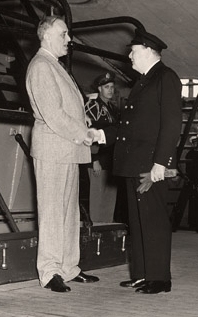
Unlike Clay and Jackson, perhaps the strongest bond between political leaders was between President Franklin D. Roosevelt and Great Britain's Prime Minister Winston Churchill during World War II. FDR was raised a Master Mason at Holland Lodge No. 8 F.& A.M. in New York in 1911. As a career politician he had limited time for Masonic activities but there is strong evidence he supported the fraternity, such as having his three sons initiated into it and becoming an honorary Grand Master of the Order of DeMolay, a Masonic youth organization. Churchill's ancestry included many Masons and he became a Master Mason at Studholme Lodge No. 1591 in 1901. Like FDR, his political career kept him from actively participating in Masonic activities, but he maintained his affiliation.

As the war began, Great Britain was essentially alone and isolated. The country desperately needed the resources and assistance of the United States. On August 9th, 1941, prior to America entering the war, the two leaders met secretly in Placentia Bay, Newfoundland. Churchill arrived on the HMS Prince of Wales and met Roosevelt aboard the USS Augusta. The two had met during World War I when FDR was the Assistant Secretary of the Navy, and Churchill as Lord of the Admiralty, a loftier position. Churchill had forgotten the meeting, which slightly perturbed Roosevelt, but years later as Prime Minister he desperately needed to know the President. Freemasonry was an important connection as it established the values both men possessed. When meeting FDR aboard the USS Augusta, Churchill gave FDR what appears to be a Masonic handshake thereby denoting their relationship. With such common values, the men were able to speak "on the level," and form a strong bond which was helpful in forging the Atlantic Charter.

I am certainly not suggesting Freemasonry was the principal influence motivating these men of history, but it certainly didn't hurt. It taught them about building relationships based on common values, protocols, and the search for "enlightenment." There are many other stories of how Freemasonry helped to shape America, such as my article on, "Montana 3-7-77 – How Freemasonry Tamed a Territory." However, as I delve into the history books I am appalled by how Freemasonry is shrugged off as an irrelevant aspect of history. It may not have the significance as purported by anti-Masonic conspirators, but it did have an important role to play in forging relationships. I just wish historians would pay closer attention to how Masonry influences the lives of people.

Keep the Faith!

Note: All trademarks both marked and unmarked belong to their respective companies.

Tim Bryce is a writer and the Managing Director of M&JB Investment Company (M&JB) of Palm Harbor, Florida and has over 30 years of experience in the management consulting field. He can be reached at timb001@phmainstreet.com

For Tim's columns, see:   timbryce.com

Like the article? TELL A FRIEND.

Copyright © 2015 by Tim Bryce. All rights reserved.

NEXT UP:  SYSTEM MISCONCEPTIONS - Is an information system the same thing as a program or "app"?

LAST TIME:  SEEKING THE TRUTH
  - How Lincoln handled the slavery issue.

Listen to Tim on WJTN-AM (News Talk 1240) "The Town Square" with host John Siggins (Mon, Wed, Fri, 12:30-3:00pm Eastern); WZIG-FM (104.1) in Palm Harbor,FL; and KIT-AM 1280 in Yakima, Washington "The Morning News" with hosts Dave Ettl & Lance Tormey (weekdays. 6:00-9:00am Pacific). Or tune-in to Tim's channel on YouTube.

Monday, January 26, 2015

SEEKING THE TRUTH

BRYCE ON HISTORY

- How Lincoln handled the slavery issue.

(Click for AUDIO VERSION)
To use this segment in a Radio broadcast or Podcast, send TIM a request.

Seeking the truth can be a delicate matter fraught with pitfalls. It may interfere with another's political agenda or personal gains. Besides, people do not necessarily want to know the truth. Most are quite comfortable hiding within their shell minding their own business, and not wanting to get involved with the outside world. Today, it is more important to be politically correct than seek the truth, something which may lead to a person being ostracized for possessing an inquisitive mind. I have run afoul of this on more than one occasion, not just in my consulting practice but in nonprofits as well. When I dare ask a question or point out an indiscretion, I am often accused of being a troublemaker. Such is the price you will likely pay. The questions though must be asked, and only a handful of people are willing to risk injury to their integrity, but they are desperate for finding the answer. One such person was Abraham Lincoln who wrestled with the question of slavery.

In the book, "The Impending Crisis," author David M. Potter, Ph.D. discusses the events leading up to the Civil War from 1848-1861. Potter was a renown history professor who won the 1977 Pulitzer Prize for this book. As a professor, the writing is very tight. It doesn't ramble, and there is a great deal of thought in each sentence.

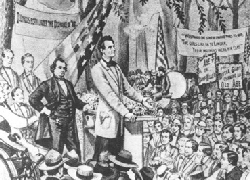
Potter's description of the legendary Lincoln-Douglas debates of 1858 (Aug 21-Oct 15) reveals the true nature of the debates, not how it is popularly depicted. To many, the debates are considered the benchmark for political campaigns, but this is where the truth is sacrificed to legend. In reality, there had never been such a series of political debates like this before or after.

The debates were organized as part of the campaign for Senator from Illinois. Stephen Douglas, "The Little Giant," represented the Democratic Party and was the incumbent. Prior to the election, he made a name for himself in the fight over the confirmation of the Kansas Constitution which would have allowed slavery. The story is long, but basically the pro-slavery forces of Kansas drafted the constitution with the slavery amendment included. In short, the Constitution was not a true representation of the will of the people of Kansas, or as Douglas referred to it as "popular sovereignty" meaning the people should decide. By defeating the Kansas Constitution, Douglas made many allies with northerners, including Republicans who considered drafting him as their candidate. Although not as renowned as Douglas, the Republicans elected Lincoln as their candidate.

Douglas was originally skeptical of sharing the spotlight with a lesser known candidate. The debates would only give Lincoln more exposure. Nonetheless, an agreement was forged to a series of seven debates to discuss the slavery issue which was at the heart of the division between North and South. The debates were cordial and mixed with humor, more importantly though, this was an in-depth intellectual process addressing a single issue which is something the country had never witnessed. Both Lincoln and Douglas presented themselves as learned men. To their audience, this was a fascinating game of mental gymnastics, and people would travel from miles away to see them.

Whereas the politicians had carefully dodged the issue of slavery over the years, going back as far as the Declaration of Independence, now the issue would be discussed openly and frankly. To Douglas, the issue was not about slavery, but of "popular sovereignty," allowing each state to make their own decision. Lincoln instead dared to grasp the bull by the horns and ask the hard questions (from the Potter book):

"I...contemplate slavery as a moral, social, and political evil: If slavery is not wrong, then nothing is wrong. I cannot remember when I did not so think, and feel."

"Where will it stop? If one man says it does not mean a Negro (as Douglas said) why may not another say it does not mean some other man?... Let us discard all this quibbling about this man or the other man - this race and that race and the other race being inferior, and therefore they must be placed in an inferior position...Let us discard all these things and unite as one people throughout this land until we shall once more stand up declaring that all men are created equal."

Lincoln's handlers advised him not to ask Douglas point-blank about his views on slavery, as it would likely cost him the Senate race. To which Lincoln allegedly responded, "Gentlemen, I am killing larger game. If Douglas answers, he can never be President, and the battle of 1860 (presidential election year) is worth a hundred of this."

While Douglas talked about "popular sovereignty," Lincoln correctly saw this as an issue of humanity. Was the Negro human or not? Even among the free states of the North, the Negro was considered an inferior race. They may have been free in the north but they were not allowed to vote, sit in a jury, or marry outside their race. It was Lincoln though, who forced the issue of their humanity. His famous "House Divided" speech at the Illinois Republican Convention of June 1858 also showed his resolve to get to the point (see following excerpt):

"We are now far into the fifth year, since a policy was initiated, with the avowed object, and confident promise, of putting an end to slavery agitation.

Under the operation of that policy, that agitation has not only, not ceased, but has constantly augmented.

In my opinion, it will not cease, until a crisis shall have been reached, and passed.

"A house divided against itself cannot stand."

I believe this government cannot endure, permanently half slave and half free.

I do not expect the Union to be dissolved -- I do not expect the house to fall -- but I do expect it will cease to be divided.

It will become all one thing or all the other.

Either the opponents of slavery, will arrest the further spread of it, and place it where the public mind shall rest in the belief that it is in the course of ultimate extinction; or its advocates will push it forward, till it shall become alike lawful in all the States, old as well as new -- North as well as South."

Please remember, nobody had the audacity to bring this subject to the forefront, and Lincoln's handlers again advised him not to use it, but he responded by saying, "The time has come when these sentiments should be uttered, and if it is decreed that I should go down linked to the truth - let me die in the advocacy of what is just and right."

Lincoln's thirst for the truth should be inspiring to us all and motivate us to keep searching for such light. However, it is particularly disheartening to find intellectual curiosity abandoned in this age of personal technology where vasts amount of information are available at our fingertips.

As expected, Douglas went on to be re-elected to his Senate seat in 1858, but Lincoln captured the presidency in 1860 thanks in large part to his ability to confront and dissect a problem. If anything, Lincoln reminds us of the difficulties and pitfalls involved with seeking the truth. Prior to this, our forefathers were content to avoid the subject and offered awkward compromises which simply delayed the inevitable. Lincoln seized the moment to put the truth in front of the people, regardless of how ugly it may have been. He well understood the issue of slavery was a ticking time bomb, something no politician dared to address.

Throughout my personal and professional lives, I have also had the unpleasant duty to point out the truth to others, which was received frostily. Nonetheless, I still seek the truth. After all, I am killing larger game.

I'll just have to remember not to attend any plays at Ford's Theater.

Keep the Faith!

Note: All trademarks both marked and unmarked belong to their respective companies.

Tim Bryce is a writer and the Managing Director of M&JB Investment Company (M&JB) of Palm Harbor, Florida and has over 30 years of experience in the management consulting field. He can be reached at timb001@phmainstreet.com

For Tim's columns, see:   timbryce.com

Like the article? TELL A FRIEND.

Copyright © 2015 by Tim Bryce. All rights reserved.

NEXT UP:  THE MASONIC ROLE IN AMERICAN HISTORY - How Masonry affected America.

LAST TIME:  WHY DO WE TOLERATE INCOMPETENCE? - Have we become too apathetic to fight back?

Listen to Tim on WJTN-AM (News Talk 1240) "The Town Square" with host John Siggins (Mon, Wed, Fri, 12:30-3:00pm Eastern); WZIG-FM (104.1) in Palm Harbor,FL; and KIT-AM 1280 in Yakima, Washington "The Morning News" with hosts Dave Ettl & Lance Tormey (weekdays. 6:00-9:00am Pacific). Or tune-in to Tim's channel on YouTube.

Friday, January 23, 2015

WHY DO WE TOLERATE INCOMPETENCE?

BRYCE ON LIFE

- Have we become too apathetic to fight back?

(Click for AUDIO VERSION)
To use this segment in a Radio broadcast or Podcast, send TIM a request.

There is only one thing worse than incompetence, and that is accepting it. I began thinking about this over the holidays when I took an ocean cruise. I have taken many such cruises over the years and have traveled on many different lines, some better than others. The line and ship I took this year was new to me. It was a large ship with about 2,200 passengers and was a part of a well known shipping line. Our destination was the Western Caribbean where I hoped to relax and catch up on my reading. I graded the food on board as "fair" at best, but I was particularly appalled by the embarking and disembarking procedures on/off the ship. Our first port of call was in the Honduras where I had scheduled a round of golf. There was only one problem, I couldn't get off the ship.
There were many other excursions planned at the same time, such as snorkeling, going to the beach, and boat rides. Everyone was asked to go to the ship's theater where they were to await instructions. Unfortunately, the people running it obviously didn't know what they were doing. What should have been a simple disembarkation process turned into an hour of madness. I've never experienced such confusion on a ship before. Even worse was returning to the ship where we were faced with a long single line of passengers. Some simple systems would have easily alleviated the problem, but the ship's personnel had no comprehension of this, nor seemed to care.

We see this same type of incompetence in the corporate world where there is no sense of systems. Instead of studying transaction processing (volume versus speed), companies are content to settle for quick and dirty programming solutions. This is like applying a Band-Aid when a tourniquet or amputation is needed. Management seems oblivious to the problem and, as such, doesn't appear to be too concerned with correcting it.

In the political and fraternal organizations I have been involved with I see little in the way of standard practices. In one particular organization, there are hundreds of jurisdictions around the world, none of which follow the exact same protocols. Even within a single jurisdiction, with several districts and hundreds of chapters, there are no standards for doing such things as taking minutes, maintaining membership records, or basic accounting. Standard practices would simplify the administrative life of the chapter and would make it possible to measure the performance of one chapter against another, but for some reason this cannot be done in today's world of the computer. In fact, the jurisdictions openly resist standards thereby affecting communications, promoting incompetence, which in turn thwarts membership and prosperity.

It is generally agreed our government is plagued by gridlock. What little legislation that is passed is based on extreme compromise. Consequently, we lack foresight, decisiveness and leadership. We also find ourselves in a reactive form of government where we are no longer in control of our destiny. We have a long history of such compromise in America. To illustrate, the Missouri Compromise of 1820 and Compromise of 1850 were designed to maintain the peace between the North and the South. They pacified conditions for the moment, but only delayed the inevitable, Civil War.

The Tea Party and Occupy Wall Street movements denote a sense of frustration with the current political system, but feel impeded from ultimately changing it (even though the Tea Party was able to successfully elect Congressmen). A legitimate third party might offer some checks and balances, but this has never been proven to be a viable option.

The lack of effective systems, methods, techniques, and skilled people has led to an era of incompetence. Normally, we would be frustrated by such problems, but are we really? I contend we have been conditioned to tolerate and accept such incompetence. But why?

First, we must understand incompetence is a man-made invention. It assumes there are better systems, methods, techniques, and skilled individuals for performing certain tasks, yet we elect to operate under inferior conditions. Instead of planning and designing suitable systems, we patch together counter-productive systems and force it upon our customers. Instead of following proper methods, techniques and tools, we use the wrong tool to drive a square peg through a round hole. Instead of trying to match the right person to the right job, we engage the Peter Principle whereby people rise above their level of competency and the cream settles on the bottom as opposed to allowing it to float to the top. We see this in companies and nonprofits where people are promoted to a level exceeding their competency. We also vividly see it in government. Politicians are one of the few professions not required certification or a degree. Doctors, attorneys, engineers and construction workers require certification, as does I.T. workers, auto mechanics and many others, but not politicians, including Congressmen and the President of the United States.

Part of our problem resides in our inability to measure productivity and customer satisfaction in a consistent manner. It is not uncommon for companies to cook the books to make the company look better than it really is (again, due to the lack of standard practices). Instead of analyzing profit margins, companies will report on volume sales (but not products recalled or returned). Instead of analyzing customer satisfaction they rely on industry press clippings. Understand this, even if you have zero defects in your manufacturing systems, but your customers are unsatisfied with your products, you have a disaster in the making. In terms of measuring work, you need to study BOTH inputs and outputs.

There are three alternatives in dealing with incompetence:

1. Acceptance - the reasons are varied, but primarily because we do not know any better and do not wish to upset the status quo, or worse, we feel powerless to fight city hall. Politics and social mores also suggest we should bite our tongues as opposed to resisting incompetence. More than anything though, we have been conditioned to accept mediocrity and inferior workmanship. We no longer applaud the craftsman, but the huckster instead.

2. Change - this represents those people unhappy with the status quo and are willing to try and change it by working lawfully within the system. Unfortunately, they are often impeded by the authorities who want to preserve the current institution.

3. Rejection - two things can happen here; either a person drops out of the system or supports an uprising to radically change the status quo. To illustrate, many young people today are frustrated by the actions (or inactions) of their federal and state governments. Consequently, they opt out by refusing to vote in elections as they see it as a pointless endeavor. The antithesis of this are the people who are willing to take up arms in opposition to the status quo. We saw signs of this recently, such as in Nevada where ranchers stared down the federal government over grazing rights.

Of these three alternatives, "Acceptance" is the most dominant, primarily because people are willing to bow to the status quo whether they like it or not; they simply do not want to fight it and, by doing so, act as a herd of animals (aka "sheeple").

Perhaps the best way to resist incompetence is to simply voice your concern. In most instances, the powers that be, corporate executives for example, are sheltered from the realities of the world through multiple layers of bureaucracy. As such, they are unaware of customer dissatisfaction or the inadequacies of their systems, until havoc strikes (which is too late). Correspondence or a telephone call to the right person in the corporate hierarchy can work wonders. However, this can only happen if the customer is not apathetic and unwilling to accept incompetence.

I have a friend who recently wanted to renew his annual membership in a local gym which is part of a national chain. The receptionist told him he could either pay month-to-month or purchase a three year membership. When he asked why they abandoned the one year membership program, she claimed they never had such a program. The manager of the gym wasn't much brighter, but instead of accepting incompetence, my friend bought a one year membership in the local YMCA (for more money I might add). After he told me his story, I urged him to send a letter or e-mail to the gym's corporate office describing the same story he had just told me. "If executives are unaware of the problem, they will never be able to correct it," I said, "You would be doing them a favor by bringing this to their attention." As of today, my friend has yet to receive a "Thank You" of any kind from the company.

In my situation, when I saw the confusion in the ship's theater, I went down to the excursion desk and asked how to get off the ship. The manager put me in touch with the exit coordinator who promptly got me off the ship. True, a little bitching can go a long way, but it shouldn't have been necessary to resort to this. The fact remains though, by not accepting incompetence, I was able to control my destiny. Had I not done so, I would have likely missed my golf outing, something I had paid for in advance.

As a consumer, I pay particular attention to incompetent service and warn my friends accordingly, such as bad restaurants, products, maintenance services, and cruise lines. In some instances, this is the only way to fight back.

Keep the Faith!

Note: All trademarks both marked and unmarked belong to their respective companies.

Tim Bryce is a writer and the Managing Director of M&JB Investment Company (M&JB) of Palm Harbor, Florida and has over 30 years of experience in the management consulting field. He can be reached at timb001@phmainstreet.com

For Tim's columns, see:   timbryce.com

Like the article? TELL A FRIEND.

Copyright © 2015 by Tim Bryce. All rights reserved.

NEXT UP:  SEEKING THE TRUTH - How Lincoln handled the slavery issue.

LAST TIME:  THE "RIGHT" AND "WRONG" OF DESIGN  - Why we need methodologies to support our work effort.

Listen to Tim on WJTN-AM (News Talk 1240) "The Town Square" with host John Siggins (Mon, Wed, Fri, 12:30-3:00pm Eastern); WZIG-FM (104.1) in Palm Harbor,FL; and KIT-AM 1280 in Yakima, Washington "The Morning News" with hosts Dave Ettl & Lance Tormey (weekdays. 6:00-9:00am Pacific). Or tune-in to Tim's channel on YouTube.

Wednesday, January 21, 2015

THE "RIGHT" AND "WRONG" OF DESIGN

BRYCE ON MANAGEMENT

- Why we need methodologies to support our work effort.

(Click for AUDIO VERSION)
To use this segment in a Radio broadcast or Podcast, send TIM a request.

People ask me why I seem to be "black and white" on so many issues. Two reasons come to mind: first, I learned early in school that you do not get credit for making a mistake. If this has changed, please let me know. Second, the nature of my work in the information systems world has taught me there are right ways of doing things, as well as wrong ways. I am also not embarrassed to admit, "I do not know," when I am unsure of myself, and will endeavor to find the answer. Failure to admit this is a sign of weakness, as is fabricating an excuse or leading someone down the wrong path.

In the many industries I have consulted with, I have learned there are right ways and wrong ways for conducting business:

* In manufacturing, there are defined methodologies for assembling just about any type of product, be it electronics, automobiles, ships, jet engines, or jets themselves. If the manufacturing sequence is not performed correctly, quality will suffer and defects will likely ensue.

* In the restaurant business, there are defined methodologies for cooking and customer service. If the cook mixes up the sequence of the recipe, believe me, you won't want to eat it.

* The construction industry is no different. Regardless of what you are building, there is a defined sequence of tasks. As a hint, when you are building a house, it is generally a good idea to lay the foundation before you start constructing the roof.

* In information systems, you better have a clear understanding of the information requirements before designing the business processes, data base, work flows, and software. Unfortunately, most systems projects are doomed from the outset as they skip over requirements and begin to program almost immediately.

The lesson here is simple; if you perform the wrong task at the wrong time in a methodology, you are doomed. As any craftsman can tell you, it is not so much about the tools you use as it is about the methodology. Skipping steps represents a calculated risk to the success of a project. Believe it or not, people in the systems field fail to comprehend this simple concept. They are convinced specifying requirements and performing the steps for design is a colossal waste of time, with the the real work being in programming. This is like suggesting we build a bridge without first studying the problem and laying out the architectural plans; that the builders should show up at the job site and begin hammering and cutting the pieces of the bridge together without a set of blueprints. Let's face it, if we built bridges in the same manner as we build systems in this country, this would be a nation run by ferryboats.

There is a science to building just about anything, be it a skyscraper, a bridge, an automobile, or an information system. It is all based on proven principles of design, it is hardly an artistic endeavor. This is not to suggest design is void of creativity; hardly, but a science is teachable and does not rely on a person's intuition. Basically, it requires discipline which is something sorely lacking in the IT industry where people prefer "shooting from the hip" as opposed to learning the proper mechanics of a methodology.

As an aside, I have a friend in the art world who teaches illustration at a Midwest College. He too appreciates the need for methodology. As he adamantly instructs his students, it is not simply about starting to draw an illustration using paper and pencil, but the necessary steps for producing a proper graphic. So you see, even in the artwork there are "right" ways and "wrong" ways for doing something. It's called a "methodology."

Yes, it really is that "black and white." Next question?

Keep the Faith!

Note: All trademarks both marked and unmarked belong to their respective companies.

Tim Bryce is a writer and the Managing Director of M&JB Investment Company (M&JB) of Palm Harbor, Florida and has over 30 years of experience in the management consulting field. He can be reached at timb001@phmainstreet.com
For Tim's columns, see:   timbryce.com

Like the article? TELL A FRIEND.

Copyright © 2015 by Tim Bryce. All rights reserved.

NEXT UP:  WHY DO WE TOLERATE INCOMPETENCE? - Have we become too apathetic to fight back?

  - Believe me, we're not alone in not knowing.

Listen to Tim on WJTN-AM (News Talk 1240) "The Town Square" with host John Siggins (Mon, Wed, Fri, 12:30-3:00pm Eastern); WZIG-FM (104.1) in Palm Harbor,FL; and KIT-AM 1280 in Yakima, Washington "The Morning News" with hosts Dave Ettl & Lance Tormey (weekdays. 6:00-9:00am Pacific). Or tune-in to Tim's channel on YouTube.