Search This Blog

Thursday, July 1, 2010

INDEPENDENCE DAY

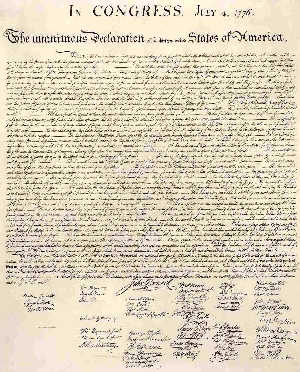
We're going to be celebrating Independence Day again this weekend and to commemorate the event, I went back and reread the Declaration of Independence. I first read it when I was in elementary school in Connecticut, along with the U.S. Constitution. However, due to the convoluted political times we now live in, I thought it might be wise to revisit this important American landmark.

A lot of the verbiage in the Declaration always seemed rather prosaic to me: "We hold these truths to be self-evident, that all men are created equal, that they are endowed by their Creator with certain unalienable Rights, that among these are Life, Liberty and the pursuit of Happiness." In other words, I was always impressed with the choice of words, sentence structure and the overall organization of the document. Simply beautiful.

Even though war had broken out one year earlier, the Declaration is still a bold document in that it was an attempt to publicly rationalize the necessity of independence not only to the people of our fledgling country but the world as well. To draft the document, Congress appointed a "Committee of Five," consisting of the best minds of the day including John Adams of Massachusetts, Benjamin Franklin of Pennsylvania, Thomas Jefferson of Virginia, Robert R. Livingston of New York, and Roger Sherman of Connecticut. Jefferson, of course, is best remembered as the principal author.

To justify independence, the authors built a strong case against the King of England and enumerated the various offenses he allegedly committed against the colonies and why such acts were intolerable. The document is truly "revolutionary" as it totally dismissed the current form of government as provided by the English; that something better was needed than an aristocracy based on a monarchy. The specific charges brought against the King also paints a grim picture and gives an interesting historical perspective of life during this period of time. If you read it carefully, you will doubtless conclude that England left us no other alternative but to revolt against the current system.

After you have read and digested its contents, you come to the realization that the signers of the Declaration were men of true resolve and determination for if independence failed, they most certainly would have lost everything, including their lives. This aspect alone is inspirational to me; to be among such men of character would be priceless.

Interesting, one of the charges brought against the King read:

"He has erected a multitude of New Offices, and sent hither swarms of Officers to harass our people and eat out their substance."

I couldn't help but chuckle over this one as I'm sure someone could use it to describe our own government today.

Happy Birthday America; 234 years young!

Keep the Faith!

Note: All trademarks both marked and unmarked belong to their respective companies.

Tim Bryce is the Managing Director of M. Bryce & Associates (MBA) of Palm Harbor, Florida and has over 30 years of experience in the management consulting field. He can be reached at timb001@phmainstreet.com

For Tim's columns, see:
http://www.phmainstreet.com/timbryce.htm

Copyright © 2010 by Tim Bryce. All rights reserved.


COMING NEXT TIME: "Tin Heads" - where transportation merges with communications. What is Bryce up to now?

Tuesday, June 29, 2010

PROTECTING INTELLECTUAL PROPERTY

The protection of intellectual property should be a significant concern to all Information Technology organizations. Without protection, commercial hardware/software vendors would quickly evaporate as others would inevitably steal their designs and programs. Corporate developers would also suffer if their ideas, inventions, and programs were misappropriated thereby causing them to lose their competitive advantage. In fact, our corporate landscape and standard of living would be radically different if we had no such protection. Fortunately, the framers of the U.S. Constitution were wise enough to implement legislation safeguarding the authorship and ownership of literature, art, and inventions, thus causing the United States to flourish in the arts and sciences. But the advent of the computer caused us to reconsider how we safeguard such property. For example, the concept of a computer program has been a bit nebulous to some people; should the source code be protected by copyright? What about the object code (executable)? Attorneys have been debating this subject over the last thirty years and there is still general confusion in the field.

In 1974, MBA embarked on our own lawsuit to protect the "PRIDE" methodology. This was a lengthy legal battle which took the courts into unchartered waters. At the time, "PRIDE" was nothing more than a methodology implemented with printed manuals and forms (no software support at the time). To safeguard our product, our lawyers drafted a standard nondisclosure agreement which all prospective buyers would sign prior to our sales presentation. Further, our contracts included similar verbiage instructing the customer to safeguard the physical embodiment of the product and not to divulge it to unauthorized third parties.

We were contacted by Arthur Young & Company in 1974 to conduct a "PRIDE" sales presentation for one of their consulting clients in Milwaukee, Wisconsin; the Harley Davidson Motorcycle Company (then a division of AMF). The attendees signed the nondisclosure agreement and the presentation was conducted as usual. Following the presentation, MBA was informed that Harley wouldn't be purchasing our product, and that Arthur Young would be developing a similar methodology for Harley instead. This made MBA suspicious, particularly since one of Young's consultants was a former "PRIDE" user. Consequently, MBA initiated a lawsuit over misappropriation of trade secrets.

This turned into a long and ugly legal battle which lasted eight years. Basically, the lawyers for the opposition contended that since the "PRIDE" materials had copyright notation printed on them, they were in the public domain. In contrast, it was our contention that "PRIDE" was a trade secret. In the end, we won the lawsuit and "PRIDE" was proven to be a trade secret in a court of law. This litigation established many precedents and is often referenced in similar cases; for additional information, see:

Chicago-Kent College of Law
Library Law

Many years have gone by since the verdict was passed. In 1989, Arthur Young & Company merged with Ernst and Ernst (now called Ernst & Young), the principals of the case have moved on and we no longer bear any ill-will towards the company. Further, "PRIDE" was placed on the Internet in 2004 (with copyright notation).

As a result of the lawsuit, MBA learned a lot about the protection of intellectual property. I may not be an attorney, but you may look upon this as a convenient primer to protect yourself.

COPYRIGHTS

Copyrights are primarily concerned with the authorized reproduction of such things as text, graphics, music, and audio/video recordings. As such, it protects publishers, authors, artists, and designers from unauthorized republication or redistribution of their work. Not too long ago, in order for a copyright to be enforceable, it had to be registered with the copyright office. However, the laws were somewhat loosened in 1976 whereby copyright protection is now effective from the moment the work is first created in fixed form. Although the use of copyright notation is no longer mandatory, it is highly beneficial to include it whenever possible to indicate your work is protected by copyright. Notation typically appears as:

"Copyright © 2007 ABC Company"

Since computer program source code is written as text, it is a wise idea to add such notation in the source code. But understand this, copyright only protects the work from unauthorized reproduction, it does not protect the author's ideas (which is how the lawyers of Arthur Young argued against us). Although the exact source code cannot be reused, it does not protect the logic of the program. To illustrate, suppose a new employee brings with him some source code from his last place of employment. Copyright protection would prohibit him from reusing the source code, but it wouldn't stop him from using the ideas contained in the program. Unfortunately, most programmers do not like to reinvent the wheel and, as such, frequently reuse source code over and over again. From this perspective, probably every company with an I.T. department is guilty of some form of copyright infringement.

TRADE SECRETS

A trade secret is much different than a copyright. Basically, it represents some unique formula, design or idea. Perhaps the best known example of a trade secret is the Coca-Cola syrup formula which is strictly protected in a vault. There are essentially two elements for establishing a trade secret; first, that it is a "unique" idea or formula, that it has distinguishable characteristics or properties to differentiate it from others, and; second, that you can demonstrate you are taking effective safeguards to protect it from unauthorized use (hence, making it a "secret"). In the lawsuit over "PRIDE", we were able to successfully demonstrate that "PRIDE" was unique and that we had taken adequate steps to safeguard unauthorized use (our nondisclosure agreement).

PATENTS

A patent is similar to a trade secret in that the inventor has a unique idea or device he wishes to prevent others from producing. To implement a patent, the idea or device must be registered with the U.S. Patent and Trademark Office. A registration process is required which includes a fee. For an invention to be patented, it must be proven to be unique, useful, and not of an obvious nature. If a patent is granted, the inventor is protected from others producing a similar invention for a limited period of time (20 years). The patent is renewable at the end of this period.

The computer field makes active use of patents to establish unique inventions and protect them from others For example, IBM typically registers the most patents each year, both hardware and software.

TRADE MARKS/SERVICE MARKS

A trademark is an arbitrary word, name, symbol, or device used to distinguish a particular product. A service mark is similar except it is used to distinguish a particular service. For example, "PRIDE" is the registered trademark of M&JB Investment Company.

Like a patent, the trade/service mark has to be registered with the U.S. Patent and Trademark Office. And, Yes, a registration fee is required. Notation normally accompanies the trademark to indicate it is registered ®. Use of such notation should be encouraged so that others know your product or service is a trademark.

A trade/service mark means no other company can use it to offer a competing product or service unless authorized by the company holding its title. As such, it is closely related to the integrity of the title company. If a competitor uses it, the public will assume they are somehow aligned with your business and, as customers of your competitor, are entitled to the same level of service or quality your business offers. If the competitor fails in this regards, it is a reflection of both your product/service and your company which could damage your business.

CONCLUSION

When MBA was founded, we were very lucky to get good, sound legal advice for protecting our intellectual property. Because of this, I encourage anyone concerned in this regard to seek such advice from a qualified attorney.

Another way to assist in the protection of your intellectual property is to enact some form of employee agreement, whereby the employee agrees not to misappropriate your products (such as designs and software), or use other intellectual property without expressed authorization. This puts your employees on notice.

Devices such as copyrights, trade secrets, patents, trade/service marks are very helpful for preventing the unauthorized use or distribution of your products. However, if someone really wants to pirate your products, they will. When you catch someone in the act though, try to give them a way out. I always recommend that you try to avoid litigation whenever possible. I find such lawsuits primarily benefit the attorneys and nobody else. But if your livelihood is genuinely threatened, as ours was, then you have no alternative but to use the full force of the law.

Keep the Faith!

Note: All trademarks both marked and unmarked belong to their respective companies.

Tim Bryce is the Managing Director of M. Bryce & Associates (MBA) of Palm Harbor, Florida and has over 30 years of experience in the management consulting field. He can be reached at timb001@phmainstreet.com

For Tim's columns, see:
http://www.phmainstreet.com/timbryce.htm

Copyright © 2010 by Tim Bryce. All rights reserved.


COMING IN JULY: "Tin Heads" - where transportation merges with communications. What is Bryce up to now?
Monday, June 28, 2010

MARRIAGE: IT TAKES TWO TO TANGO

After seeing so many marriages end in divorce, you cannot help but wonder why couples get married in the first place. Maybe they see it as some kind of legal permission slip to do nothing more than to have sex. If so, that seems to be rather shallow thinking to me. I tend to believe most people get married to quell the biological clock in their heads to reproduce. Under this scenario, husband and wife are doomed to failure after their mission has been fulfilled. There are probably dozens of reasons for getting divorced, but regardless, I think most people go into marriage with impractical expectations and hidden incompatibilities that are slow to surface.
Perhaps the biggest misconception about marriage is that it is easy; that by simply getting married all of your difficulties you experienced as a single person will somehow disappear. Hardly. If anything, your problems are only beginning as you have to learn to live with a new person unfamiliar with your customs, mannerisms, and lifestyle. I have yet to meet the couple who was perfectly compatible at the time of taking their marriage vows. Regardless of how long you may have lived with someone prior to marriage, you really don't know the person until it becomes "legal."

A lot of people seem to fail to grasp that marriage is a partnership. This disturbs me greatly. It involves forming a team which means working together towards common goals and objectives. True, each person has their own unique duties and responsibilities, but to make such a partnership work, it is necessary for both give and take, for compromise, which some people have the ability to accept and adapt to, while others cannot. This means you cannot always do the things you did unilaterally when you were single. Now you must consider and consult your partner. Like any business venture, you must do what is best for both parties, not just one. This is the part of marriage most people seem to have trouble with. Any time one party ignores or excludes consideration for the other, the marriage is doomed.

If you have any doubt whatsoever about getting married, don't do it. You must go into it with both eyes wide open and possess a genuine willingness to try to work together. Anything less will inevitably result in either an unhappy marriage or a nasty divorce.

Just remember, it takes two to tango.

Keep the Faith!

Note: All trademarks both marked and unmarked belong to their respective companies.

Tim Bryce is the Managing Director of M. Bryce & Associates (MBA) of Palm Harbor, Florida and has over 30 years of experience in the management consulting field. He can be reached at timb001@phmainstreet.com

For Tim's columns, see:
http://www.phmainstreet.com/timbryce.htm

Copyright © 2010 by Tim Bryce. All rights reserved.


COMING IN JULY: "Tin Heads" - where transportation merges with communications. What is Bryce up to now?

Friday, June 25, 2010

THE WORLD'S BEST

I find it rather amusing when people start touting their products as the "world's best" or "world's finest." Such boasts are usually self-proclaimed and are not based on some independent person or group to impartially judge the products. In fact, such superficial claims detract from the company's credibility as opposed to adding to it. For example, try an Internet search on "World's Best (whatever)" and you'll undoubtedly run into more opinions than facts.
I've been a baseball fan for a number of years, but even I snicker when I hear Americans brag about their "World Series" as the world championship. We've got some great talent in this country and in all likelihood we may very well win such a championship, but I think there are a lot of countries who would love to participate in such a series. Actually, calling it the "World Series" without such participation smacks of arrogance.

For years there has been a long ongoing argument amongst rock and roll aficionados as to which was the "World's Best" band; with the Beatles, Rolling Stones, and Led Zepplin often mentioned. As much as I liked all three groups, I would have to say most adamantly, "Who cares!?" Isn't it enough they each sold millions of records, made a lot of fans, and tons of money? Why can't we just enjoy them for who they are?

There is something twisted in the American character requiring us to formulate a pecking order for everything thereby establishing bragging rights. I guess it is due to the competitive nature of this country. Somehow I don't understand the logic when people say they have the "world's best" philly cheese steak, chicken wings, chili, or whatever. Isn't it sufficient to simply say something is either good or bad?

This obsession with "world's best" has become so obnoxious, I openly laugh whenever I see it, which in Manhattan seems to be everywhere. Next time you see "world's best" written down, ask the proprietor to show you the certificate awarded to them and the statistics used by the judges in the competition. Better yet, ask them if they would be willing to participate in an independent contest whereby you'll act as the "world's greatest" judge. Don't be surprised if they balk at the offer.

Keep the Faith!

Note: All trademarks both marked and unmarked belong to their respective companies.

Tim Bryce is the Managing Director of M. Bryce & Associates (MBA) of Palm Harbor, Florida and has over 30 years of experience in the management consulting field. He can be reached at timb001@phmainstreet.com

For Tim's columns, see:
http://www.phmainstreet.com/timbryce.htm

Copyright © 2010 by Tim Bryce. All rights reserved.


COMING IN JULY: "Tin Heads" - where transportation merges with communications. What is Bryce up to now?

Wednesday, June 23, 2010

IMPLEMENTING BUSINESS ETHICS

We hear a lot these days about the deterioration of ethics in business, e.g., graft, corruption, cheating, favoritism, skimming money, etc. This has resulted in a public relations nightmare for business. If consumers do not trust a company, its a matter of time before it goes out of business. This is supported by recent studies that give evidence there is a correlation between business performance and ethical practices (see the Institute of Business Ethics).Basically, the Institute's study suggests there are long-term benefits associated with enacting an ethics programs. Such studies and recent corporate snafus (e.g., Enron) are impetus for companies coming to grips with ethics in the workplace.

There are essentially two considerations for devising an ethics program in business; first, knowing what your ethics are, and, second; implementing them in a consistent manner.

INTERPRETING ETHICS

There is little point in my telling you what is ethically right or wrong. You already have an interpretation of this. But let us understand what influences our interpretation of ethics; our interpersonal relations with others, such as our family, friends, neighbors, fellow workers, as well as the media. Ethics is learned more than it is taught. It is based on observations of the conduct of others, people we like and respect as opposed to those we do not. It is then up to each of us to interpret these perceptions from which we will base our conduct and behavior. The point is, we act on our perceptions, however accurate or inaccurate they may be. Another influential factor are our own human frailties of competitiveness, love, greed and ambition. But then again, this goes back to interpersonal relations.

Let us recognize that ethical behavior is interpreted differently from person to person. What one person may consider right or wrong may be different for the next person. The objective in business is to implement a uniform form of behavior thereby instilling consumer confidence in a company overall.

IMPLEMENTATION

Writing a corporate code of conduct is in vogue today as a means of articulating the ethics of a business. Such codes are proudly displayed on web sites and in corporate brochures more for public relations than anything else. True, they are useful for disciplining an employee for an infraction of the rules, but I do not see them as an effective way of implementing an ethics program. Understand this, regardless of what the code of conduct states, the ethics of a business are whatever the top-dog says they are. Too often I have seen companies say one thing, then act another, e.g., Enron.

Printed codes of conduct are nice, but we have to recognize that it is one thing to enact legislation, quite another to enforce it. As stated earlier, ethical behavior is based on observations. Regardless of what a code of conduct says in print, ethical behavior is based on the relationship of superior and subordinate worker relationships. If a subordinate observes an indiscretion by his superior, in all likelihood it will be emulated by the subordinate. This phenomenon occurs top-down in the whole corporate chain of command. If it breaks down anywhere in the corporate hierarchy, it will become visible to the subordinate layers and potentially create a "trickle-down" effect. This means the boss has to be a role model for ethical behavior; they must "walk-the-walk" as well as "talk-the-talk." If they do not, it will not go unobserved by their subordinates. Managers, therefore, should avoid the "do as I say, not do as I do" phenomenon. They must lead by example. Anything less is sheer hypocrisy and will inevitably lead to changes in behavior.

It is simply not sufficient to issue platitudes as to what is and what isn't ethical behavior. The manager must follow-up and assure ethical behavior is implemented accordingly. In other words, we shouldn't just "desire" truth and honesty, we must "demand" it. If one person gets away with an indiscretion, others will surely follow. As such, when writing out a code of conduct, be sure to stipulate the penalties for its violation.

The success of a business ethics program is ultimately measured by how well it becomes ingrained in the corporate culture. As we have discussed in the past, corporate culture pertains to the identity and personality of the enterprise. All companies have a culture; a way they behave and operate. They may be organized and disciplined or chaotic and unstructured. Either way, this is the culture which the enterprise has elected to adopt. What is important is that in order for an employee to function and succeed, they must be able to recognize, accept and adapt to the culture. If they do not, they will be rejected (people will not work with them).

The intuitive manager understands the corporate culture and how to manipulate it. Changing the Corporate Culture involves influencing the three elements of the culture: its Customs, Philosophy and Society. This is not a simple task. It must be remembered that culture is learned. As such, it can be taught and enforced. For example, a code of conduct is useful for teaching, as is a system of rewards and penalties. Designating people to act as watchdogs of the culture can also be useful, but be careful not to create a climate of paranoia. Ultimately, as a manager, you want to create a culture that promotes the ethical behavior you desire.

CONCLUSION

We now live in strange socioeconomic times. 40-50 years ago we normally had one parent staying home to raise the kids. Now it is commonplace to find families where both the husband and wife are working and paying less attention to their children, thereby relegating their parenting duties to teachers and coaches. In other words, the family unit, which is the basic building block for learning ethical behavior, is becoming severely hampered.

In business today we have a "fast-track" competitive mentality which does not encourage a spirit of teamwork but, rather, more rugged individualism. Nor does it promote employee loyalty. Further, we now live in a society that encourages people to go into debt, thereby causing financial tensions.

Bottom-line, ethics is about people and trust. Consequently, we should be sharpening our people skills as opposed to avoiding it. We don't need more maxims of how we should conduct our lives; we need to lead by example. As such, we need more role-models and heroes than we do paperwork.

Let me close with one last thought on how ethics impacts business; there is probably nothing worse in business than being caught in a lie, particularly by a customer. Any trust that there may have been before disintegrates immediately and business is lost. In this day and age, there is something refreshingly honorable about a person where their word is their bond. Ethics just makes good business sense.

Keep the Faith!

Note: All trademarks both marked and unmarked belong to their respective companies.

Tim Bryce is the Managing Director of M. Bryce & Associates (MBA) of Palm Harbor, Florida and has over 30 years of experience in the management consulting field. He can be reached at timb001@phmainstreet.com

For Tim's columns, see:
http://www.phmainstreet.com/timbryce.htm

Copyright © 2010 by Tim Bryce. All rights reserved.


COMING IN JULY: "Tin Heads" - where transportation merges with communications. What is Bryce up to now?

Monday, June 21, 2010

EXCESSIVE USE OF PROFANITY

I've noticed profanity has become a natural part of the teenager vernacular lately, perhaps excessively so. I know teachers and parents who are very much concerned with this and are at a loss as to how to handle it. In my school days, we were all well aware of the words but knew better to use them in the presence of adults as schools still practiced corporal punishment back then. If you got out of line, you weren't just sent to detention, you were swatted with a paddle.
A lot has changed since then. Today, only 20 states in the country allow corporal punishment in schools (not including here in Florida). As many as 25 countries have outlawed it altogether. I guess this is another area where lawyers have gotten involved and threatened lawsuits on behalf of irate parents who refuse to discipline their own children and subject the rest of us to these clods.

In studying this issue, I noticed all 50 states in the country allow corporal punishment on the part of parents. Yet, I wonder how many parents actually exercise such action. Again, back when I was a kid, if you got out of line, the old man would take a belt to your hide or your mother would wash your mouth out with soap if you spoke foul language (as happened to Ralphie in the movie, "A Christmas Story"). My great grandmother would use a switch or fly swatter if necessary. Such corporal punishment was not unique to my family as just about every kid on the block was keenly aware of the penalties for stepping out of line. It's called, "cause and effect"; if you screwed-up, you had to suffer the consequences. Believe me, we would have much preferred to have been "grounded" than face the wrath of a displeased parent. Being "grounded" just didn't exist back then.

I'm not sure why teens use profanity excessively; perhaps it is to appear "cool" or something they learned through the media, but it sure seems they drop the "F-bomb" as if it is a common everyday word. I'm no saint myself when it comes to swearing, but as an adult you realize there is a time and place for everything and you tend to use it more judiciously than our youth. Excessive use of profanity does two things; first, it waters down the effect of the word. Whereas profanity is normally used to stir emotions, inordinate use negates its effect. Second, excessive profanity is a significant indicator of someone's intellect. Rudimentary language reflects a rudimentary intellect. I am reminded of the old maxim whereby, "Profanity is the attempt of a lazy and feeble mind to express itself forcefully."

When youth uses profanity in the presence of adults, it does not threaten or embarrass adults as much as it causes the youth in question to lose all credibility in the adult's eyes. It is just not smart to do. I find it rather amusing when youth resorts to primitive profanity as opposed to articulating their position. It most definitely does not make them look more mature.

As for me personally, I tend to think of profanity along the same lines as Mark Twain who said, "In certain trying circumstances, urgent circumstances, desperate circumstances, profanity furnishes a relief denied even to prayer." Amen!

Keep the Faith!

Note: All trademarks both marked and unmarked belong to their respective companies.

Tim Bryce is the Managing Director of M. Bryce & Associates (MBA) of Palm Harbor, Florida and has over 30 years of experience in the management consulting field. He can be reached at timb001@phmainstreet.com

For Tim's columns, see:
http://www.phmainstreet.com/timbryce.htm

Copyright © 2010 by Tim Bryce. All rights reserved.


COMING IN JULY: "Tin Heads" - where transportation merges with communications. What is Bryce up to now?

Thursday, June 17, 2010

THE MISSOURI COMPROMISE PARALLEL

A few months ago, I happened to make a comparison between the period leading up to the American Civil War (1820-1860) and the discourse of today. I wish to take this a bit further so people can better understand the parallel.

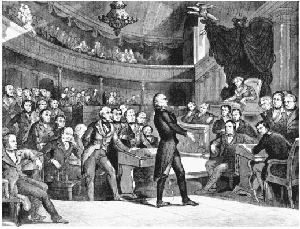
Back in the early 1800's, the country was still divided over the question of slavery, primarily along sectional lines, north versus south. As the young country began to expand in a westerly direction, both sides grew concerned over losing power in Congress through the annexation of new states on either side of the slavery issue. If one side gained more votes than the other, it was conceivable they could implement policies and laws detrimental to the other side. Although there was initially balance between the states, a flash point erupted when the citizens of Missouri applied for statehood as a slave state. This led to an impasse in both houses of Congress as the discourse heated up. The debates were so passionate they began to draw large audiences in the galleries. Both sides were adamant in their position and settlement of the issue seemed impossible.

After several attempts, the Missouri Compromise was finally drafted whereby Missouri would be allowed to join the country as a slave state, and Maine, which had been a part of northeastern Massachusetts, was admitted as a free state, thereby maintaining parity over Congress. Further, an amendment was added whereby slavery would be excluded in all territories and future states north of the parallel 36°30' north (the southern boundary of Missouri).

The compromise was a clumsy document and only delayed the inevitable dispute over slavery. Former President Thomas Jefferson believed it would eventually lead to the destruction of the Union. He summed up the sentiments of the day in a letter to his friend, John Holmes on April 22, 1820; Jefferson wrote:

"...But this momentous question, like a fire bell in the night, awakened and filled me with terror. I considered it at once as the knell of the Union. It is hushed indeed for the moment. but this is a reprieve only, not a final sentence, a geographical line, coinciding with a marked principle, moral and political, once conceived and held up to the angry passions of men, will never be obliterated; and every new irritation will mark it deeper and deeper."

For the next thirty years, both sides carefully watched the balance of power. In 1836 when Michigan was admitted as a free state, Arkansas was admitted as a slave state. The Compromise of 1850 dealt with the admittance of Texas and consideration for states in the southwest, including California.

It wasn't until the passage of the Kansas–Nebraska Act of 1854, drafted by Senator Stephen A. Douglas of Illinois, that the Missouri Compromise was finally made obsolete. Under the Act, the voters of each state would determine the issue of slavery internally, not by the Congress, thereby negating the intent of the Missouri Compromise. Although the Act was intended to appease both sides, it was ultimately perceived as supporting the slave powers of the South.

The debate over the Act went on for four months and featured the political luminaries of the day, including Douglas, Salmon P. Chase (OH), William Seward (NY), and Charles Sumner (MA). The New York Tribune wrote on March 2nd that, "The unanimous sentiment of the North is indignant resistance," which sounds remarkably like Republicans in Congress today.

The Kansas-Nebraska Act eventually passed but set the country on a course towards Civil War. In the process, it caused chaos among the political parties which were split up and redefined. For example, it gave rise to the Republican Party in 1856 which primarily consisted of northerners who were antislavery.

PARALLEL

Both disputes, then and now, are cultural in nature. Whereas slavery was the issue driving the disagreements of the early 1800's, today it is socioeconomics. Both issues were extremely divisive and incongruous to the point of being irreconcilable. Today's discourse is every bit as bitter and reminiscent of the period preceding the Civil War, and the void between the two sides is just as large and insurmountable. Again, it is all about control over the Congress and which side will force their way of life on the other.

If the Missouri Compromise and Civil War has taught us anything, the only way such sharp disputes can be resolved is through armed conflict. This is not only a scary proposition for the country internally, but it would have far reaching effects on the world at large, as it would finally present the opportunities our enemies have been waiting for in order to dismantle the free world.

I sincerely hope nobody truly wants armed conflict as we should have learned this lesson through our first Civil War, but the divisiveness of the country makes you wonder how we can possibly avoid it. Let us not forget, the period leading up to the Civil War spawned zealots like abolitionist John Brown who advocated and practiced armed insurrection. You have to wonder who will be the zealot of our time.

Keep the Faith!

Note: All trademarks both marked and unmarked belong to their respective companies.

Tim Bryce is the Managing Director of M. Bryce & Associates (MBA) of Palm Harbor, Florida and has over 30 years of experience in the management consulting field. He can be reached at timb001@phmainstreet.com

For Tim's columns, see:
http://www.phmainstreet.com/timbryce.htm

Copyright © 2010 by Tim Bryce. All rights reserved.


COMING IN JULY: "Tin Heads" - where transportation merges with communications. What is Bryce up to now?